

Your dog’s blood results came back with one line flagged high: ALP, short for alkaline phosphatase. On its own, that flag does not mean something serious is wrong. ALP is one of the most commonly raised values on a canine chemistry panel, and on a page full of flags it is often one of the least alarming. What it means depends on how high it is, your dog’s age, any medication your dog takes, and what the rest of the liver bloodwork shows. Those four things decide whether the next step is a simple recheck or more testing.

How Common a High ALP Is and Where It Comes From
In one large series of canine blood samples, ALP was raised in 39 percent of dogs. It was highest in puppies under a year old, at 71 percent, and in dogs over eight, at 51 percent, and lowest in between, at 28 percent. The flag is close to routine at both ends of a dog’s life.
ALP is an enzyme involved in bile flow and bone building. A little of it always circulates in the blood, and the level climbs when the body makes more of it or when the cells holding it are stimulated or irritated.
In dogs, it comes mainly from three places: the liver and its bile ducts, bone (especially in a growing puppy), and a steroid-induced form that only dogs make. That third source is the one that surprises owners. Cortisol switches it on, whether it comes from the dog’s own adrenal glands or from a steroid tablet. That is part of why ALP runs high in dogs more often than in cats or other species.
What a High ALP Can and Cannot Tell You
Two more figures show how well ALP performs as a test. In published data on canine ALP, about 80 percent of dogs with hepatobiliary disease had a high value, yet roughly half of dogs without it had a high value too. ALP is good at catching liver and bile duct disease and poor at confirming it. A high ALP by itself is not a diagnosis: it does not automatically mean liver failure, Cushing’s disease, or cancer, and many dogs with a raised value feel completely normal. It mostly tells your vet to keep looking, and the rest of the panel, your dog’s history, and the trend over time decide what it means.
When ALP rises, it usually reflects one of two processes. The first is bile not flowing normally through the liver, a pattern vets call cholestasis (Greek for “bile” and “a standing still”). The second is something telling cells to make more of the enzyme, such as hormones or growing bone. ALP is a marker of response, not necessarily of damage, which makes it different from liver enzymes such as ALT that rise mainly when liver cells are injured.
How High the Value Is, and in Which Dogs
The size of the rise changes the reading. A mild rise in a growing puppy is often just bone at work. ALP in growing animals can run two to ten times higher than in adults with no disease at all. A moderate rise in a dog taking prednisone may simply be the medication. A very high ALP alongside other abnormal liver values is the pattern that deserves a closer look.

The timing of medication trips people up. Steroids such as prednisone, the seizure drug phenobarbital, and some other drugs can raise ALP without real liver damage, and the rise does not vanish the day the drug stops. Drug-related ALP increases from phenobarbital usually return to normal within two to four weeks of stopping. Steroid-related ones can take several months, so a recheck done too soon after a course of steroids can still look high. Make sure your vet has a full list of what your dog has taken in the last few months, ideally before the blood is drawn rather than after.
Cushing’s disease sits at the far end of the range. A raised ALP is the most common lab abnormality in Cushing’s disease, and the increase can be dramatic, sometimes tens of times above the reference range.
Common Reasons ALP Goes Up
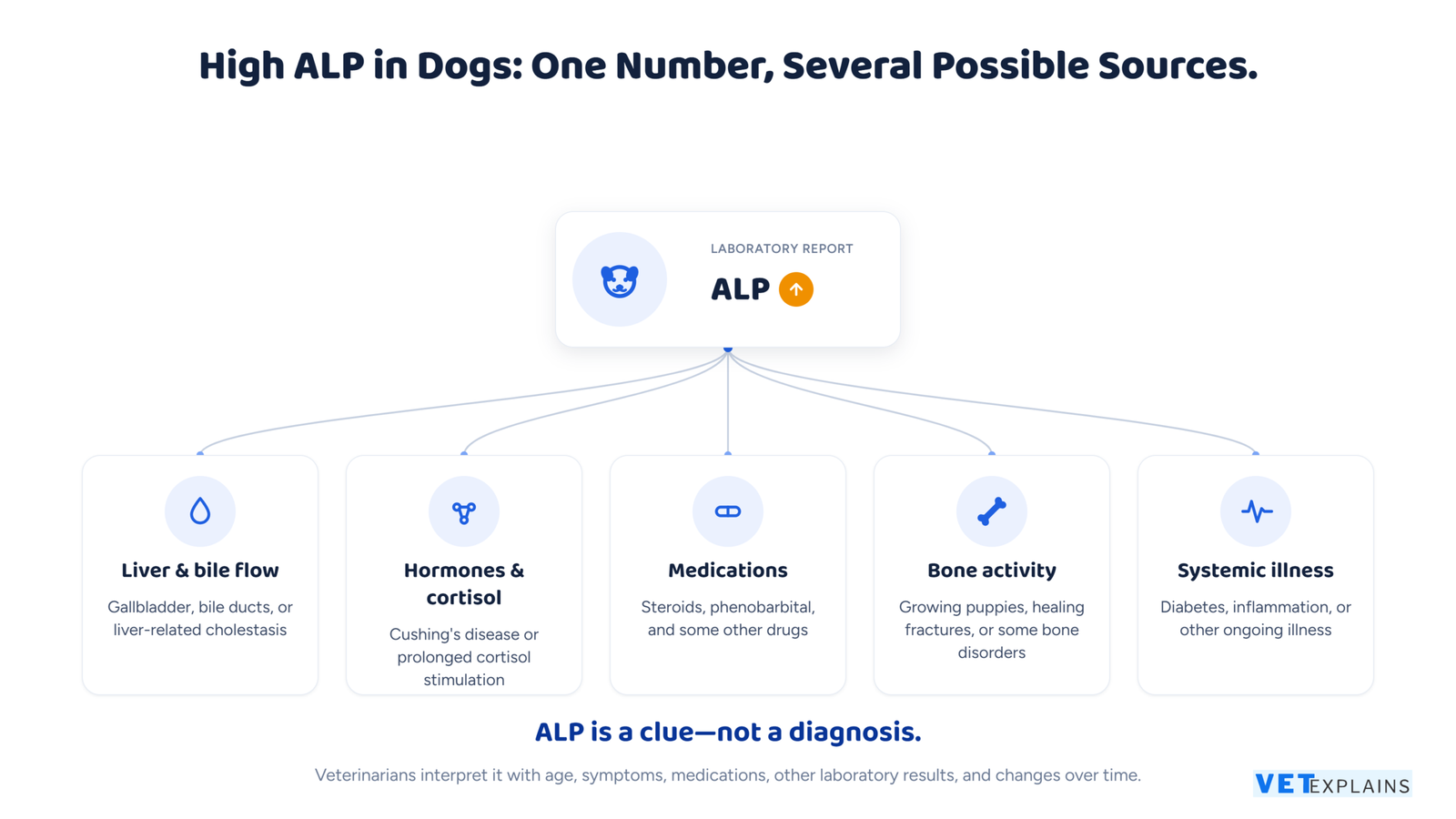
Anything that slows bile flow can push ALP up: gallbladder disease such as a gallbladder mucocele, a blocked bile duct, chronic hepatitis, liver tumors, and vacuolar hepatopathy. In older dogs, the most common reason for a mild to moderate ALP that creeps up slowly is benign nodular hyperplasia. These are nodules of extra liver tissue that come with age and are usually harmless. When the liver is the cause, you may see a poorer appetite, vomiting, low energy, more drinking and peeing, or, in advanced cases, yellow gums or eyes (jaundice). Many dogs show no outward signs at all, especially early on.
Cortisol is the other big cause. Cushing’s disease (hyperadrenocorticism) and long-term steroid medication both keep it high. The signs that travel with them are fairly distinctive: drinking and peeing much more, a bigger appetite, thinning hair or skin changes, and a pot-bellied look. An older dog with a high ALP and that picture is exactly who hormone testing for Cushing’s is meant for. It is not a screening test for a healthy dog with a high number and no signs.
Bone is another source. Puppies and adolescents are building it fast, and in adults, bone disease such as a tumor or infection can raise ALP too. Illness elsewhere in the body matters as well: diabetes, an underactive thyroid, pancreatitis, and inflammatory bowel disease can all raise it. ALP does not cause symptoms itself. It reflects what else is going on, which is why it is the start of a question rather than the answer.

What Happens Next
The first question needs no laboratory: does your dog seem unwell? These are the signs worth mentioning to your vet alongside a high ALP, because they point toward the liver or Cushing’s disease rather than a harmless rise.
- 01
Eating less
Skipping meals or losing interest in food that used to vanish
- 02
Vomiting
Bringing up food or liquid, even if your dog otherwise seems fine
- 03
Low energy
Sleeping more than usual or less keen on walks
- 04
Drinking and peeing more
Emptying the water bowl faster or needing to go out more often
- 05
Yellow gums or eyes
A yellow tinge to the gums, the whites of the eyes, or the skin
- 06
Always hungry
Begging, scavenging, or finishing meals faster than before
- 07
Pot belly or thin coat
A rounder belly with thinning or patchy hair
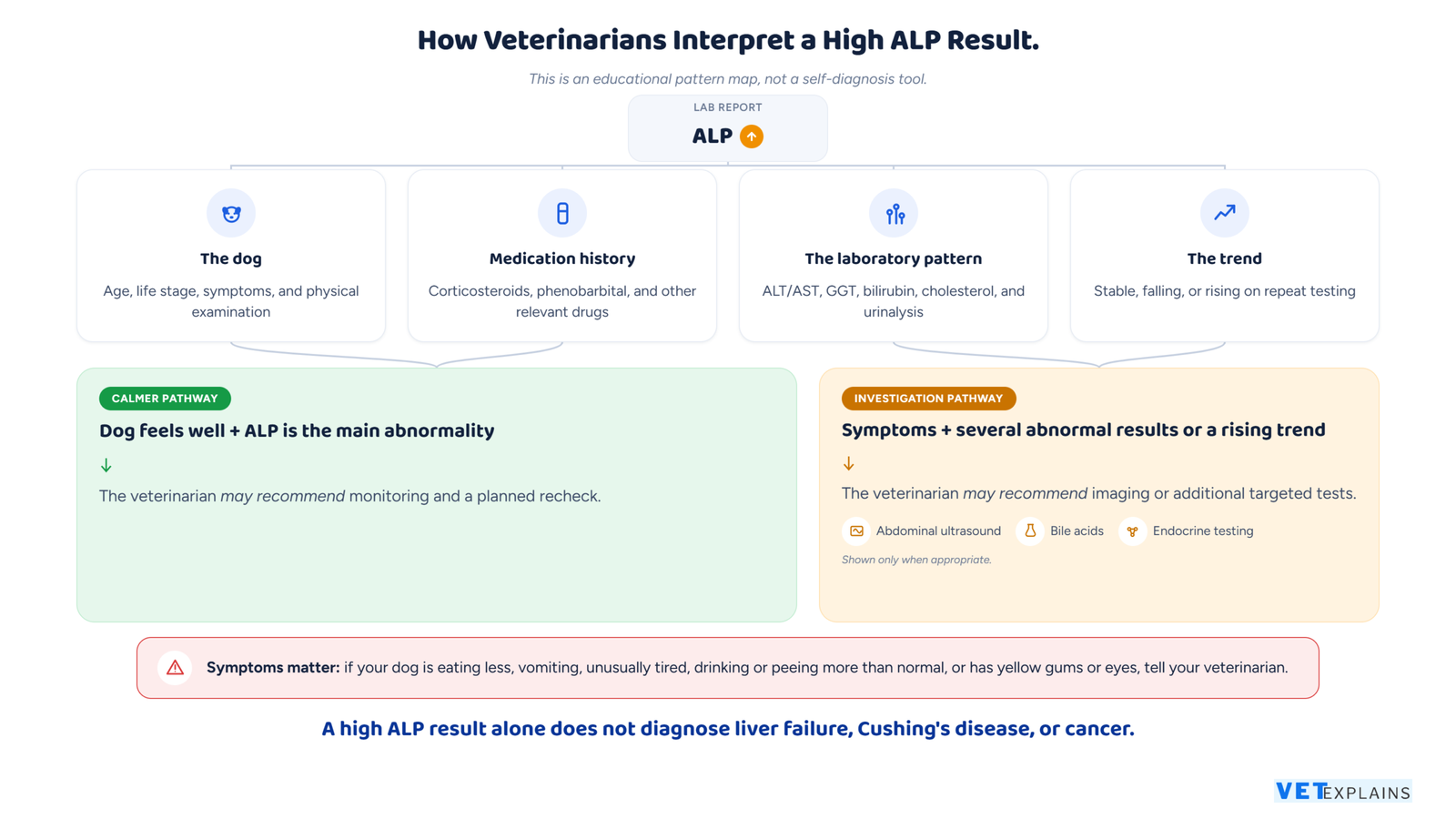
A high ALP in a dog showing any of these is a reason for more testing now, not a wait-and-see recheck. That workup usually starts with a full chemistry panel, including AST, GGT, bilirubin, and cholesterol, plus a urinalysis and an abdominal ultrasound. Depending on what those show, your vet may add bile acids testing or hormone tests for Cushing’s disease, such as the ACTH stimulation test or the low-dose dexamethasone suppression test.
If your dog feels well and ALP is the only real abnormality, the plan is usually calmer. When the value is under about five times the top of the reference range, periodic monitoring is a reasonable approach, with an abdominal ultrasound if it stays high. The trend matters more than any single number. A value that holds steady or falls is reassuring, while one that keeps climbing deserves a closer look. If your dog is bright and eating well, I would book the recheck and not lose sleep over one result.
If ALP stays elevated across rechecks, you may also wonder about dietary support for elevated liver enzymes or liver-support supplements. Ask your vet first, since not every diet or supplement fits every underlying cause.
Was the article helpful?
can stress cause high ALP levels?
Hi Lee, thank you for the question. Elevated ALP has many possible causes, including liver disease, bile duct obstruction, certain medications (like corticosteroids or phenobarbital), also can be normal in younger dogs. Short stress would probably not have an influence on ALP levels, long-term stress might. Keep in mind the larger picture of liver enzymes, I would recommend to further focus on this article https://vetexplains.com/dog-liver-bloodwork/ and this one https://vetexplains.com/dog-liver-tests-explained/ Hopefully, this will help you answer all your questions!