
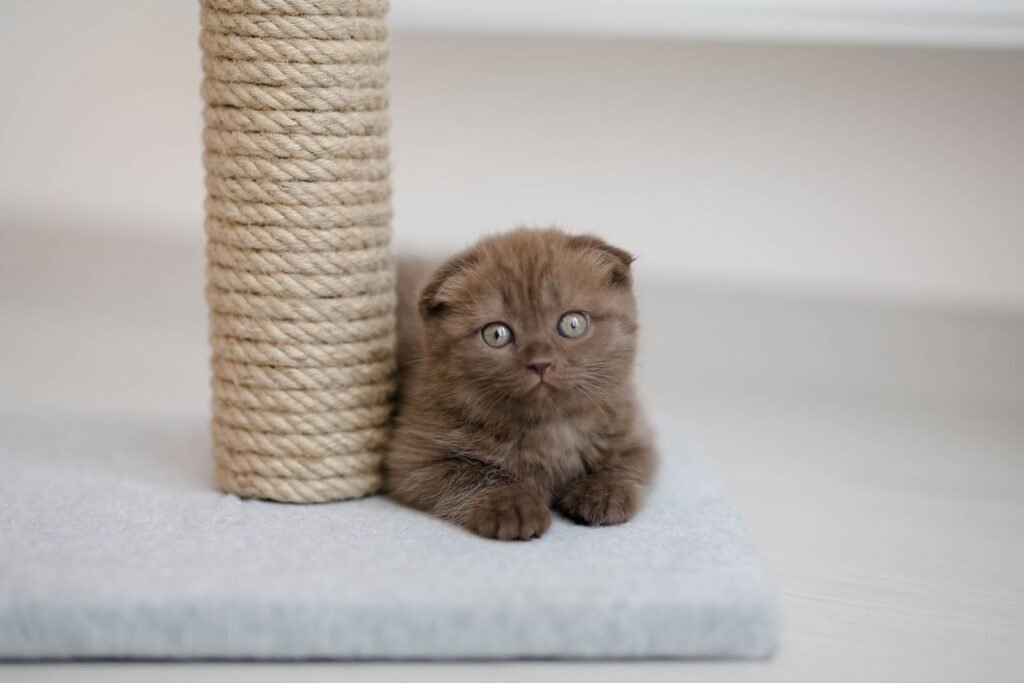
You have already repaired the arm of the sofa once, and you would rather not do it again. A scratching post can solve this, as long as it is the right shape and stands where your cat actually spends time. Scratching is not misbehavior, and cats do not grow out of it. It is how they keep their claws in working order and leave a mark other cats can see and smell.
You also already have most of the information you need. The material your cat chose, the angle they scratch at, and the room they do it in all point to the right post. A post bought without that information is the one that ends up standing untouched in the hallway.
Here are the three side by side. The sections below explain how to match one to your cat and where to put it.


Product prices and availability are accurate as of the date/time indicated and are subject to change.
Why the Sofa Keeps Losing
Scratching does three jobs at once. It strips the worn outer sheath off the claws, stretches the whole front half of the body, and leaves scent from glands on the paws. None of those needs goes away because you bought furniture you like, so the aim is never to stop the behavior. It is to give it somewhere better to go.
Punishment is the usual first move, and it does not work. In a survey of cat owners, punishment made no measurable difference to how often their cats scratched. Cats do not connect it with the scratching, so punishing a cat for scratching mostly teaches them to do it while you are out of the room.
Declawing, or onychectomy (from the Greek onyx, claw, and ektome, a cutting out), is not a shortcut either. Despite the everyday name, the surgery amputates the last bone of each toe. Declawed cats were found to have higher odds of back pain, biting and house soiling than cats who kept their claws. Nearly two thirds of them had fragments of toe bone left behind.
What Your Cat Has Already Told You
Start with the damage. In the same survey, about five in six cats were scratching something their owner would rather they left alone. Chairs and other furniture were the most common target, with carpet close behind, and fabric and carpet were worked on more than any other material. That matters, because a bare sisal post feels nothing like either of them.
Then look at what your cat picked. A cat grinding away at the side of an armchair is asking for something upright, firm, and tall enough to stretch into. A cat who shreds the carpet by the bedroom door is asking for something flat or gently angled, on the floor, near where they already lie down. Get this backwards and the new post is easy for your cat to ignore.

If you cannot tell which your cat prefers, start upright. The same survey found cats used standing posts more often than flat scratch pads. A cardboard pad costs little, so adding one later to see whether your cat takes to it is a cheap experiment.
Height, Grip, and the Wobble Test
Height matters most. Your cat should be able to reach up, hook in, and stretch the full length of the back with the hind feet still on the floor. That means a post at least as tall as your cat standing on the hind legs with the front legs stretched up. A post that stops at shoulder height gives none of that stretch, and the stretch is half the appeal. Measure against the sofa arm your cat has been using and buy taller than the scratch marks.
Stability is next. Lean on the top of the post with the weight of your forearm. If it rocks, your cat will feel that on the first hard pull and may not come back to it. A wide, heavy base does more for this than a thick post does.
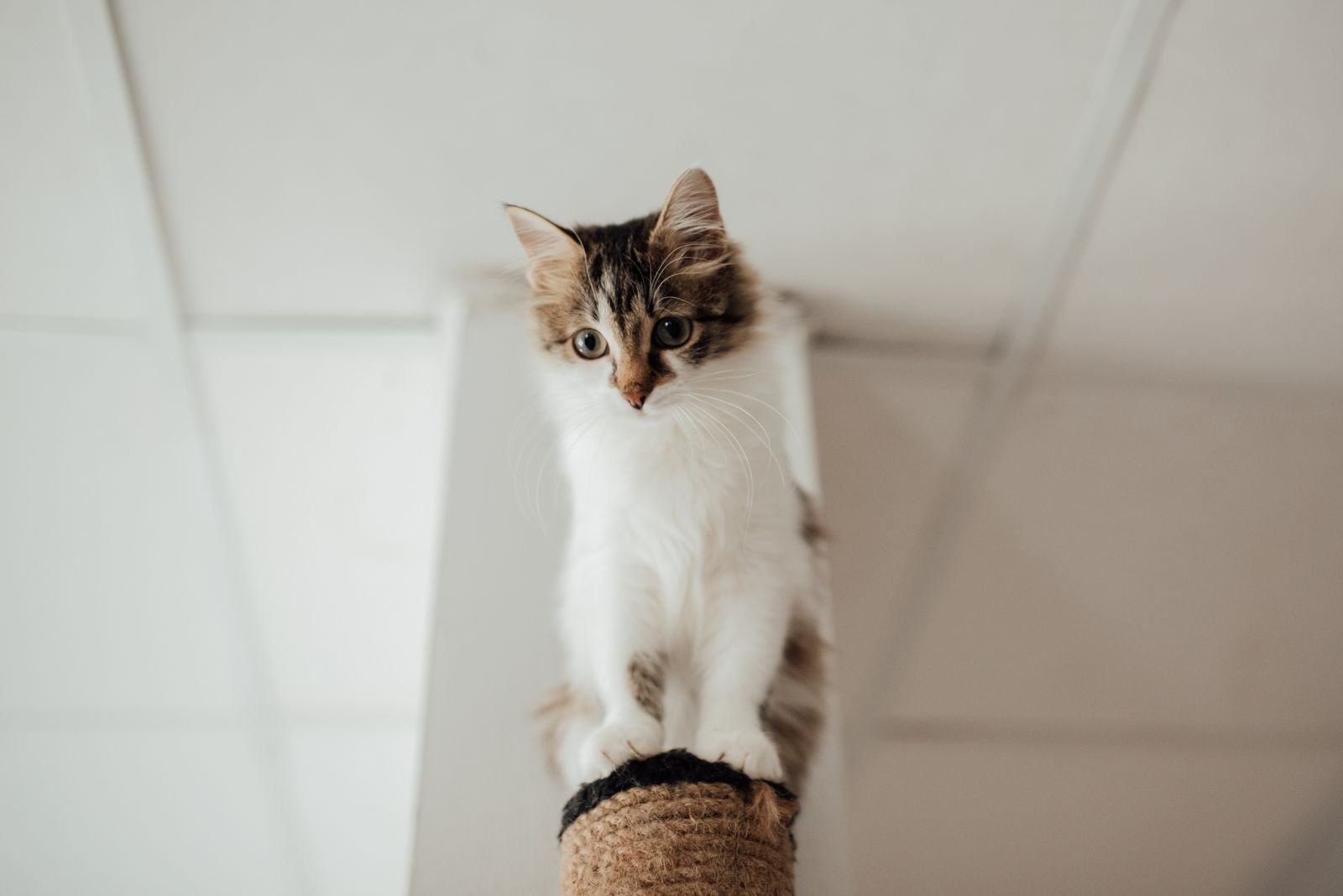
Then the surface. Sisal rope has ridges that catch a claw and lets a cat pull down hard without the post coming apart. Corrugated cardboard shreds satisfyingly, costs little to replace, and suits horizontal scratchers. Most cats, though not all, prefer a rough surface they can shred, so a carpet-covered post is rarely the first choice. It can still suit a cat who has been working on your rugs.
A cat tree applies the same rules, stacked, with places to sit added. It earns the floor space in a busy multi-cat household, or in an apartment where the floor is already crowded. Cats need somewhere high to sit and somewhere private to withdraw to as much as they need something to scratch. In a one-cat home with a spare corner, a single good post does the same job for far less money.
Compare These Cat Scratchers
These three cover the shapes most cats will accept. The SmartCat Pioneer Pet Ultimate is the plain upright, a tall sisal column on a wide base, and the one to reach for when the damage is on furniture arms. The PetFusion Jumbo Lounge is the horizontal option, a curved cardboard slab that doubles as a bed and suits carpet scratchers. The Feandrea tower is a full cat tree, five levels with scratching surfaces throughout, and makes sense for a cat with nowhere high to go.
Buy for the shape your cat already chose rather than the one that suits your living room. I would rather see a cheap cardboard lounge sitting in the middle of the floor where the cat wants it than a handsome tower in a corner nobody visits.
Placement Does More Than the Product
Where the post stands matters as much as which post you buy, and it costs nothing to get right. In a study of more than twelve hundred cats, posts placed in areas the cat already used were better at redirecting scratching than posts tucked out of the way.
Put the post beside the thing being scratched, not across the room from it. Cats often scratch after waking, so spots near where your cat sleeps and room entrances are good places to start. Once the post is being used reliably, you can move it a few inches a day toward somewhere you would rather have it.
Resist carrying your cat over and pressing their paws against it. In the owner survey, cats whose owners placed them next to the new item used it less rather than more. Rub a little catnip into it, play around the base, and let your cat find it in their own time.
Two good posts in different rooms will do more than one perfect post in the wrong place. The rest of a cat’s essentials work the same way, better spread out than lined up in one spot. Put a second litter box somewhere separate from the first. Keep water away from the food bowl, and a water fountain makes that easy.
When Scratching Means Something Is Wrong
Two changes are worth a closer look before you buy anything else.
The first is a cat who used the tall post happily and has quietly stopped. Cats hide joint pain well. When one hundred cats older than six were X-rayed, 61 percent had signs of osteoarthritis (from the Greek osteon, bone, and arthron, joint) in at least one joint. A cat who has stopped jumping up to the high perches, or now only scratches at floor level, may be sore rather than bored. Put a low horizontal scratcher down in the meantime and book a vet visit, because arthritis in cats is more common than most owners expect.
The second is a sudden increase. In that large study, heavier scratching went along with longer play sessions, nighttime activity, disruptive behavior, and having a child in the home. When the scratching comes with urinating outside the litter box, look into why a cat pees outside the box rather than treating it as a discipline problem.
It is also worth checking what is actually being scratched. A cat scratching at their own skin rather than the furniture has a different problem entirely. Fleas are one of the first things to rule out, even in indoor cats. If that is the cause, flea treatment for cats is where the fix starts.
One kind of litter box trouble cannot wait. If your cat is straining in the litter box and passing little or no urine, go to an emergency vet now, especially if he is male. That can be a urethral obstruction, a blocked urethra. Potassium then builds up in the blood until it slows and disturbs the heartbeat, and a cat with a complete urinary blockage can die in less than a day or two. Do not wait for morning.
This article is for educational purposes only and is not a substitute for professional veterinary care. Always consult a licensed veterinarian regarding your pet’s health and nutritional needs. As an Amazon Associate, Vet Explains earns from qualifying purchases.
Was the article helpful?
My Norwegian is too tall for almost all scratching posts. I’ve got an old one that’s both tall enough and stable (many don’t have a large enough base), but the carpet is worn out.
they sell floor to ceiling cat posts that are just one long post covered in sisal. I’m pretty sure that will be big enough for your cat. Or you could go to a carpet store and ask for scraps or to a store like the Habitat for Humanity Store and buy some leftovers and replace the carpet on the one you already have.