
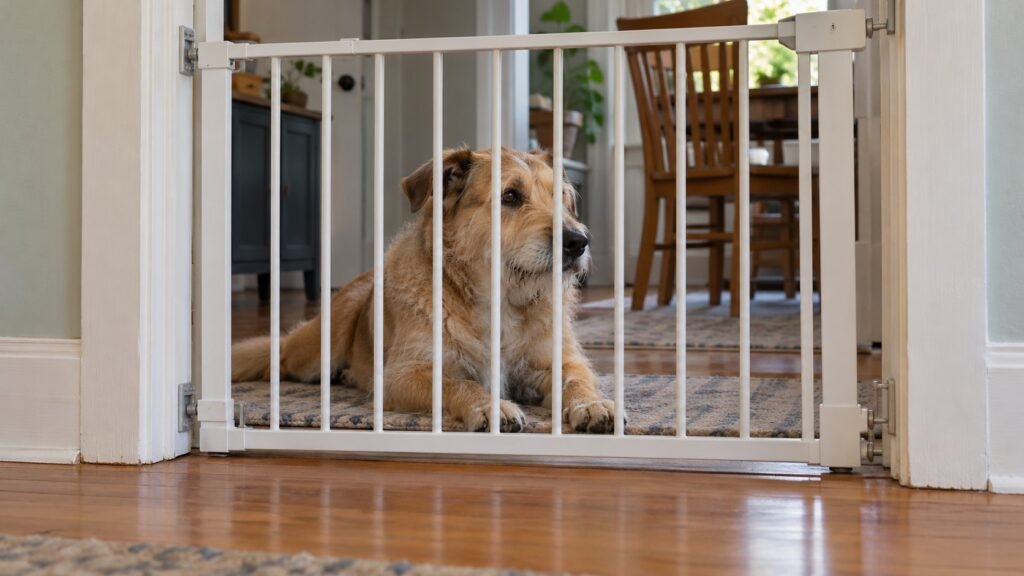
A dog gate looks like the easiest thing in the house to buy, and it still goes wrong in a predictable way. It fits on the day you put it up, then the dog leans on it or hits it at a run, and one evening it is lying on the landing. How a gate is fixed in place matters far more than the brand on the box.
Gates stay up in one of two ways: friction against the walls, or screws. A pressure mounted gate is fine across a doorway or at the bottom of the stairs. At the top of a staircase it is the wrong choice, and the manufacturers warn against it themselves. For most homes three gates cover it. The Regalo Easy Step is the inexpensive, proven one for doorways. The Cumbor screws to the frame and closes behind you, so it goes at the top of the stairs. The Carlson has a small door that a cat can use and a dog cannot.
If your veterinarian has told you to keep your dog off the stairs after surgery or a back problem, start with the recovery section below. In that situation the gate is how the instruction actually gets followed at home.
What a Gate Is Actually Solving
Most people buy a gate for one job and end up using it for several. A gate blocks the stairs, guards the front door, gives a cat her own half of the house, or keeps the dog out of one room. On the stairs the gate must not move. For the cat it needs a way through. Across the kitchen it just has to stay shut.
The kitchen is worth a word of its own. Chocolate, raisins and sugar free sweets are all foods that are toxic to dogs, and they tend to sit right at nose height on a counter or coffee table. Training helps, but a closed gate still works when nobody is watching.
Pressure Mounted or Screwed to the Wall
A pressure mounted gate stays up because rubber feet push outward against both sides of the opening. Nothing is screwed in, so there are no holes and you can move it in a minute. That same design is its weakness. A dog who leans on it day after day, or hits it at full speed, can slowly walk the frame out of position until it gives way.
In a doorway, that failure means a dog in the wrong room. At the top of a staircase it means a dog and a metal frame going down the stairs together. So the rule is simple: never use a pressure mounted gate at the top of the stairs. Regalo says the same on its own product listing.
A hardware mounted gate is fixed to the door frame or the newel post with four screws. It swings on hinges, and a dog cannot push it out of place, which is why it belongs at the top of the stairs. If you rent, put the screws into the wooden frame or trim rather than the plaster. Four small holes are easy to fill when you move out.

Measuring Before You Buy
Measure the opening at the top and again at the bottom, then buy for the smaller number. Door frames and stairwells are rarely square, and a gate that fits snugly at hip height can be half an inch short at the floor. A determined dog will find that gap.
Next, make sure your opening does not fall between sizes. These gates widen with fixed extension panels, so each one fits a couple of ranges with nothing in between. The Regalo fits 29 to 32 inches on its own and 35.5 to 38.5 inches with its 6 inch extension. The Carlson fits 29 to 32 inches, then 34 to 36.5 with its 4 inch extension. A 33 inch doorway fits neither, and tightening the tension will not change that.
Height is the number people overlook. All three gates stand about 30 inches, which stops a Dachshund easily and a Labrador who has made up his mind much less reliably. If your dog has already jumped a gate, a taller one is not always the answer, because a jumper pushes off the top rail. A gate that stays rigid when he hits it helps more.
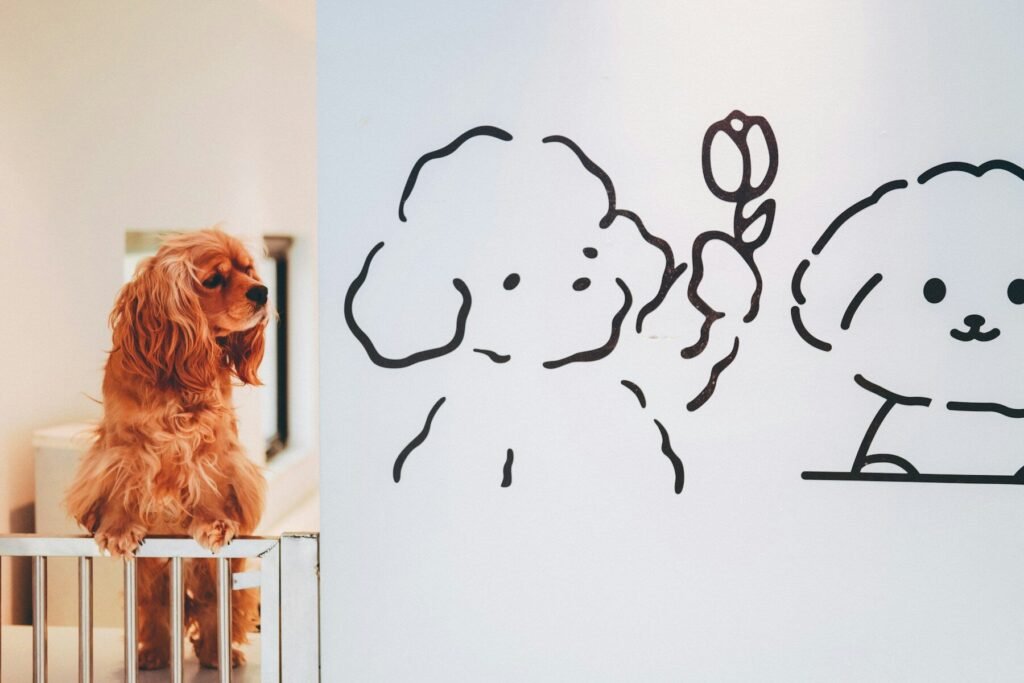
Two more measurements rarely make the product title: the gap under the gate and the width of the walk through door. Small terriers often try going under before they try going over. And a narrow door gets old fast. The Carlson’s 16.5 inch opening lets you through with a laundry basket, and a gate you have to climb over twice a day is the one that ends up propped open.
When the Gate Is Part of a Treatment Plan
If your dog is recovering from a knee or back problem, read this section first. Home care for these usually comes down to limiting movement for weeks, and that cannot depend on everyone in the house remembering every single time, including the visiting relative who lets the dog out. With a gate across the stairs, nobody has to remember.
The cranial cruciate ligament is the main stabilizing ligament in a dog’s knee, and a tear is one of the most common reasons for hind leg lameness. After cruciate ligament surgery, activity has to be restricted for several weeks while the repair heals, and the procedures that cut and realign the bone need several weeks of strict confinement.
Intervertebral disc disease is the same problem in the spine. The cushion between two vertebrae bulges or ruptures into the spinal canal and presses on the cord. For a first, mild episode, cage rest and confinement are the usual conservative treatment, and the long term advice includes keeping the dog from jumping off furniture. Dachshunds account for somewhere between 45 and 70 percent of all cases. If you own one, a gate at the bottom of the stairs is preventive care, not an overreaction.

Older dogs deserve the same thinking before anything is diagnosed. Hard floors and stairs are where an unsteady senior dog slips. Home changes for less mobile dogs often start with a gate on the stairs and a carpet runner or grip tape on the treads. Stiffness after a nap, hesitating at the first step, or a new way of getting off the sofa can be early signs of arthritis rather than plain old age. If stairs are already hard, a ramp or a set of steps at the sofa or bed saves those joints a lot of small jumps.
Confinement has one more side effect. A dog shut behind a gate for weeks gets bored, and a bored dog rests far less than you hoped. A food puzzle or a stuffed chew gives him something to do with his nose instead of his legs. A comfortable, supportive bed on his side of the gate helps when he is sore.

Gates in a House With a Cat
In a house with a dog and a cat, a gate does a different job. A cat needs some resources the dog cannot reach: food, water, a litter tray and somewhere high to retreat to. When introducing a cat and a dog, a corridor or staircase blocked by a gate is one of the standard ways to give the cat her own space. Raised perches she can escape to are the other half.
The catch is that an ordinary gate shuts the cat out along with the dog. That is the reason to choose the Carlson. It has a small lockable door built into the frame, sized for a cat and too small for a medium or large dog. The cat keeps the run of the house, the litter tray stops being a snack bar for the dog, and the cat food stays with the cat.
Give the cat height on her side of the gate too. A cat tree or a tall shelf next to the barrier lets her go up as well as through. And if it is the dog who falls apart every time the doorbell rings, that may be anxiety rather than bad manners, which is worth understanding before you blame the training.
Three Dog Gates Worth Buying
All three are metal and have long review histories, but they are not interchangeable. They differ in how they mount, what they cost, and whether anything smaller than the dog needs to get through.

The pressure mounted default for doorways and the foot of the stairs.

Hardware mounted and self closing, built for the head of a staircase.

A built-in cat door lets the cat through and keeps the dog out.
Product prices and availability are accurate as of the date/time indicated and are subject to change.
The Regalo Easy Step is the default. It is the cheapest gate here I would trust with a real dog, and it fits openings from 29 to 38.5 inches. With well over a hundred thousand ratings, its weak points are well known. It is pressure mounted only, so use it in a doorway or at the bottom of the stairs.
The Cumbor is the one to buy when the gate has a safety job rather than a tidiness job. It can be screwed in as well as pressure mounted, it swings shut behind you, and the double lock makes it the right pick for the top of a staircase. It costs roughly twice as much, and the top of the stairs is exactly where that money is well spent.
The Carlson is the multi-pet choice. It costs about the same as the Regalo, fits a slightly narrower range of 29 to 36.5 inches, and the cat door is the whole reason to pick it.
A dog who suddenly cannot manage the stairs needs a veterinarian, not a gate. Sudden weakness in the back legs, a hind end that wobbles or drags, or a yelp when you lift him can mean a disc has ruptured and is pressing on the spinal cord. A ruptured disc is treated as a true surgical emergency, and losing pain sensation in the legs carries a poor outlook that worsens the longer it lasts. If your dog cannot stand or walk on his back legs, go to an emergency veterinarian now instead of waiting to see whether it settles overnight. Buy the gate afterwards, for the recovery.
This article is for educational purposes only and is not a substitute for professional veterinary care. Always consult a licensed veterinarian regarding your pet’s health and nutritional needs. As an Amazon Associate, Vet Explains earns from qualifying purchases.
Was the article helpful?