
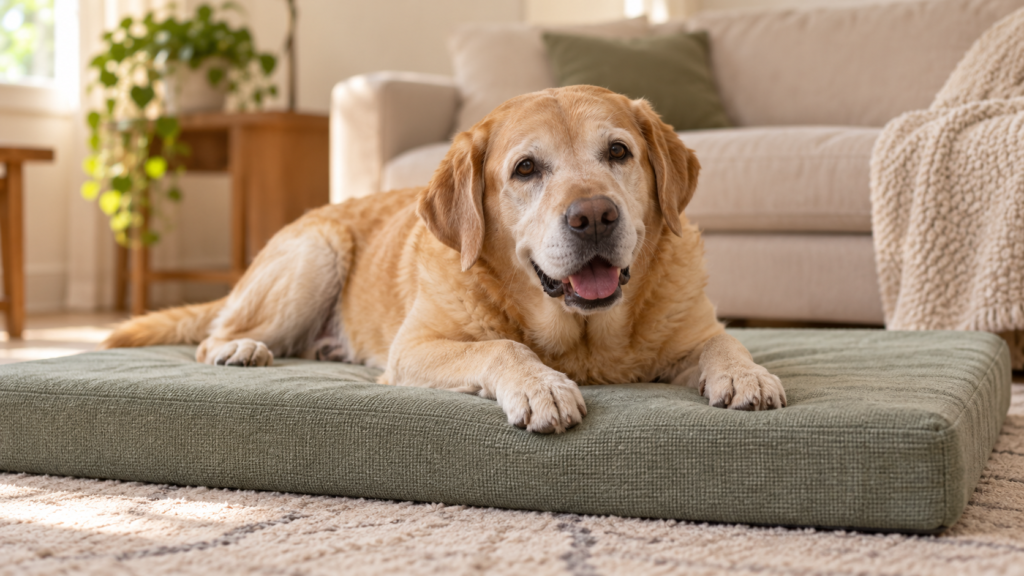
An older dog who circles the same spot three times and then lowers herself down in stages is telling you something about her joints. For a dog like that, look for a solid core of real foam, at least four inches thick for a small or medium dog and six or seven for a large one. Add a cover that comes all the way off and goes in the washing machine, and a waterproof liner between the two.
Skip anything filled with shredded foam or polyester batting, whatever the listing calls it. Under a heavy dog it packs flat within a season.
The reason to bother is that stiffness in an old dog is usually the early stages of arthritis, and an arthritic dog spends a lot of her day lying down. In a study of nearly half a million dogs in UK general practice, the average age at diagnosis of osteoarthritis was ten and a half years. Osteoarthritis comes from the Greek osteon, bone, and arthron, joint, with the ending -itis for inflammation. Dogs heavier than average had more than twice the odds of being diagnosed, and Golden Retrievers and Labradors were among the breeds at higher risk. Those are the dogs for whom the surface under them starts to matter.
What a bed cannot do is treat the arthritis. No mattress replaces weight control, pain relief, or an honest conversation with your vet about how far along your dog is. A good bed makes the hours she already spends lying down more comfortable and protects her elbows while she is there, and that is worth paying for on its own terms.
Here are the three side by side. The sections below explain how to tell real orthopedic foam from a label and how to size the bed.


Product prices and availability are accurate as of the date/time indicated and are subject to change.
What Makes a Bed Orthopedic, and What Just Says So
Orthopedic has no fixed meaning on a pet bed label, and it ends up printed on beds that are a sack of chopped foam with a zipper. Pick the bed up before you trust the label. If it folds easily in half, or you can press your fingers nearly through the middle, your dog’s hip will be resting on the floor through it by spring.
What you want is a single piece of foam, or a layered build with a firm base under a softer top. Thickness does most of the work, because foam can only spread a dog’s weight if there is enough of it between bone and hard floor. Four inches is a sensible minimum for a dog under about fifty pounds. Large and giant breeds do better on six or seven, and that is the one place the expensive beds genuinely earn their price.
Density matters as much as thickness, and almost no listing tells you what it is. The practical test is how fast the foam pushes back after you press a fist in and let go. Good foam returns in a second or two. Cheap foam holds the dent, and a dent is a thin spot.
Egg crate foam has a real place, though not the one the marketing suggests. For a dog who is down most of the day, memory foam or an egg crate mattress is the usual advice. Thick, soft padding lowers the risk of pressure sores, which is why it features in care for pets who cannot walk. For a dog who still gets up and potters around, a solid slab is the better buy.
Sizing, Height, and Where the Bed Goes
Measure your dog stretched out at her longest, nose to the base of the tail, and add six inches. Then watch how she sleeps. A sprawler needs the full length, and a curler needs less floor and more depth. Buying a size up is rarely a mistake.

Bolsters are where people choose badly. A raised rim looks cozier, and plenty of dogs like resting a head against one. But it is one more obstacle for a dog whose back end is unreliable. For a dog with sore elbows, the rim is exactly where the elbow lands as she pushes herself up. A flat mattress, or a bolster along one side only, is easier to get on and off.
Total bed height is a step, and that works against thickness. A seven inch mattress sounds wonderfully supportive, but it is also a seven inch step up for a dog who is already struggling to get up from the floor. If your dog has reached the point of needing a ramp or steps for the car, keep the bed low and firm rather than tall and plush.
Placement decides whether any of this gets used. A cold, hard floor is the last place a stiff dog wants to lie. The bed on the tile by the back door is the one she walks past on her way to the carpet. Put it where the family sits and out of a draft. Non-slip rugs around it help too, and they are standard advice for osteoarthritis in dogs. A dog who expects her feet to skid stops lying down and getting up freely.

The Washing Problem Nobody Puts on the Box
Old dogs leak, and it is one of the less talked about parts of getting older. Some of it is incontinence, some is a dog who could not reach the door in time, and some is drool. Whatever the cause, the bed gets wet, and foam that gets wet does not really dry. It stays damp in the core, it starts to smell, and then you are buying the bed again.
So you want two layers between your dog and the foam: a cover that unzips completely and survives a machine wash, and a waterproof liner underneath that the foam never gets past. Check that the cover truly comes all the way off, because plenty of beds unzip along one edge and no further.
If the wetness is new, do not put it down to old age and buy a liner. A dog who has started drinking far more than usual and leaks overnight may have a problem with her kidneys, her blood sugar or her hormones. That deserves a urine sample at the vet rather than a mattress protector.
Getting an Older Dog to Use the New Bed
Dogs are conservative about where they sleep, and a new bed smells like a warehouse. Put it exactly where the old one was, lay the old blanket on top for the first week, and feed a few meals beside it. Do not lift her onto it, because that teaches her the bed is something that happens to her.
Give it two weeks. Dense foam feels firmer than a flattened old bed, and some dogs need a while to decide they like it.
If she still will not settle after two or three weeks, the bed is probably not what is wrong. Night pacing in an old dog can be canine cognitive dysfunction rather than discomfort, or pain that is not controlled well enough to let her lie still. Either one is a conversation with your vet, not a return label. And a few dogs simply want a cave rather than a mattress, in which case a covered den bed is the honest answer.
Three Orthopedic Dog Beds Worth the Money
These three suit three different situations. The Big Barker seven inch memory foam mattress is what I would want under a large, stiff dog: flat, with no rim to climb, and thick enough to still be working in three years. The JOYELF memory foam bed is the sensible middle, with a bolster on part of the edge and a cover that comes off easily. It suits a dog who likes something to lean on but can still step up. The EHEYCIGA waterproof bed is for the dog who has accidents, because the waterproof layer is built in rather than sold separately.
Buy for the dog in front of you, not the one in the product photo. A premium mattress is wasted on a thirty pound terrier, and a budget pad will not last under an eighty pound Labrador.
When the Bed Is Not the Problem
The change with the best evidence behind it is not a purchase at all. In obese dogs with arthritis, lameness improved measurably once they had lost between six and nine percent of their body weight. Keeping a dog lean throughout her life also helps slow how fast arthritis progresses. Pain relief chosen with your vet matters as well. A bed supports all of that, but it cannot stand in for it.

Watch the pressure points while you are at it. Where a bony point presses into a hard surface for long enough, the blood supply to the skin over it is cut off and the tissue breaks down. That is how decubital ulcers, or pressure sores, start. Decubital comes from the Latin decumbere, to lie down. Elbows and hips are the usual spots, especially in a heavy dog on thin bedding. If you can already see a bald, thickened patch over an elbow, a better bed is part of the answer and a look from your vet is the other part.
A dog who has started limping on one leg rather than being generally stiff is a different problem. Stiffness that is worse first thing and eases with movement fits arthritis. A single sore leg that appeared this week does not, and it is worth having examined.
Go to a vet immediately if your dog suddenly cannot stand, cannot place one or both back feet, or is dragging a back leg. That is not arthritis getting worse overnight. It can be an intervertebral disc that has ruptured into the spinal canal and is pressing on the cord. With disc disease in dogs, the sooner surgery happens, the better the outlook, so do not wait for morning.
This article is for educational purposes only and is not a substitute for professional veterinary care. Always consult a licensed veterinarian regarding your pet’s health and nutritional needs. As an Amazon Associate, Vet Explains earns from qualifying purchases.
Was the article helpful?