
Table of Contents
Scooping litter twice a day gets old fast, especially with more than one cat or a schedule that doesn’t leave room for it. Self-cleaning litter boxes have gotten a lot better and cheaper over the past few years, but the range on Amazon runs from $30 gravity boxes to $600 robots with apps and health tracking. Here’s what’s actually worth paying for, and what to check before you buy anything with moving parts your cat has to trust.
Quick answer: Introduce a self-cleaning box gradually and leave the old one available during the switch, so your cat always has a box they already accept. Prioritize adjustable sensitivity, compatibility with the litter your cat already uses, and an easy manual override. Cats are split about evenly between covered and open boxes, and the guidelines favor open ones because they make daily scooping and monitoring easier [AAFP/ISFM house-soiling guidelines]. Kittens, senior cats, and cats with mobility problems are usually better served by a simple open box, which is easier to step into and easier to see into.
Why Owners Switch to Self-Cleaning Litter Boxes
A box that is only scooped once a day can smell strong enough by evening that some cats start looking for alternatives, like a corner of the closet or the edge of the bathmat. Guidelines say waste should be removed at least once a day [AAFP/ISFM house-soiling guidelines]. Multi-cat households feel this most. The usual rule is at least one more box than the number of cats, and even a single-cat home is advised to keep two boxes in two separate locations [AAFP/ISFM house-soiling guidelines], which is easier to follow when one of them handles itself.
Self-cleaning boxes also cut down on ammonia buildup between full litter changes. Odor is one of the quieter reasons a cat starts avoiding a box, and cats will generally go back to using one once it is clean and smells neutral again [AAFP/ISFM house-soiling guidelines].
What to Actually Check Before You Buy
Not all “self-cleaning” claims mean the same thing. A few things worth checking on the product page before you add to cart:
- Anti-pinch safety sensors. Any automatic rake needs infrared or weight sensors that stop the mechanism the instant a cat steps back in mid-cycle. Check the listing and reviews specifically for this, not just “safety features.”
- Litter compatibility. Some automatic boxes only work well with clumping clay litter of a specific granule size; crystal-based systems use proprietary trays. If your cat is picky about texture, check compatibility before switching both the box and the litter at once.
- Noise level. Some cats do not care. Others startle at a motor starting behind them mid-business, and a bad first experience can put a cat off the box. If you have an anxious cat, this matters more than any other spec on the list.
- How it fails. Power outage, jammed rake, app not connecting. What happens then? A box you can still scoop manually without tools is worth more than one that’s useless the one week the sensor glitches.
Automatic vs. Manual Self-Cleaning: Which One Fits
“Self-cleaning” covers two pretty different categories. Fully automatic boxes use a motorized rake or globe rotation, on a timer or weight sensor, to separate waste after each use. Most empty into a sealed compartment you clear every one to two weeks. They are the closest thing to hands-off, and most now include an app for cycle history and waste alerts. That is genuinely useful, because a cat visiting the box unusually often, or straining and producing little, is showing signs that need a vet [Cornell Feline Health Center].
Manual self-cleaning boxes (roll, sift, or rake-by-hand designs) still require you to do something, but that something takes ten seconds instead of a full scoop-and-bag routine. There is no motor, no sensor calibration, and nothing to jam. They suit multi-cat households on a budget, cats who are nervous around machinery, and anyone who wants the odor benefits of frequent waste separation without trusting electronics around a litter box.
Two Solid Options Worth Comparing
Two well-reviewed options from opposite ends of that spectrum:

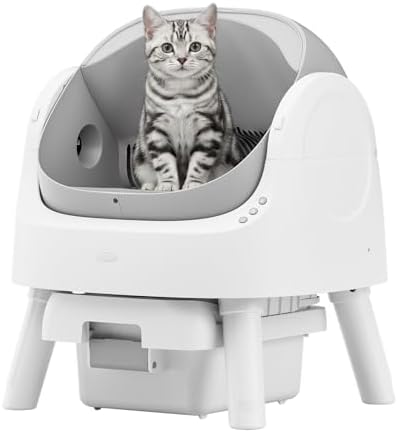
The open-top automatic option runs its rake on a timer with anti-pinch infrared sensors, works with standard clumping litter, and pairs with an app for cycle history. It is the closer-to-hands-off pick. The Omega Paw Elite skips the electronics entirely. You roll the whole unit like a barrel once or twice a day, and a built-in sifter separates clumps into a bottom tray while clean litter falls back through. Both work easily for a single cat. For two or more, expect to empty either one more often than the listing’s “per cat” estimate suggests.
Introducing a New Box Without Setting Off a Litter Strike
Cats are creatures of habit about exactly this, so do not swap the old box out the day the new one arrives. Set the new box up next to the old one and leave both available for at least a week. If it is a motorized box, let your cat investigate it powered off first. Then run a cycle or two while they are in another room, so the sound is not a surprise the first time they are standing in it. Only remove the old box once you have seen your cat use the new one on their own, unprompted, more than once. Once a cat has settled on a box, the guidelines advise leaving it where it is for a couple of weeks before changing anything else [AAFP/ISFM house-soiling guidelines].
If you’re also switching litter type as part of the upgrade, change one variable at a time. A new box and a new litter on the same day gives you no way to tell which one a reluctant cat is actually objecting to.
See a vet the same day if: your cat stops using the litter box entirely, strains without producing urine, cries out in the box, or you notice blood in the litter. In male cats especially, straining with little or no urine output can mean a urinary blockage. That is a genuine emergency, not a litter box preference problem, and it is life-threatening: after a complete obstruction, death may follow in less than 24 to 48 hours without treatment [Cornell Feline Health Center]. Do not wait to see whether the new box is the cause before ruling this out.
Further Reading
Why Is My Cat Peeing Outside the Litter Box? Common Reasons If a litter box switch doesn’t go smoothly, this covers the behavioral and medical reasons a cat avoids the box, beyond just disliking the new hardware.
Best Hairball Remedies for Cats A useful companion buying guide if hairballs are part of what is landing outside the box in the first place.
Kitten Vaccination Schedule Worth a look if you are setting up a litter box routine for a new kitten alongside their other early care needs.
This article is for educational purposes only and is not a substitute for professional veterinary care. Always consult a licensed veterinarian regarding your pet’s health and nutritional needs. As an Amazon Associate, Vet Explains earns from qualifying purchases.
Was the article helpful?