
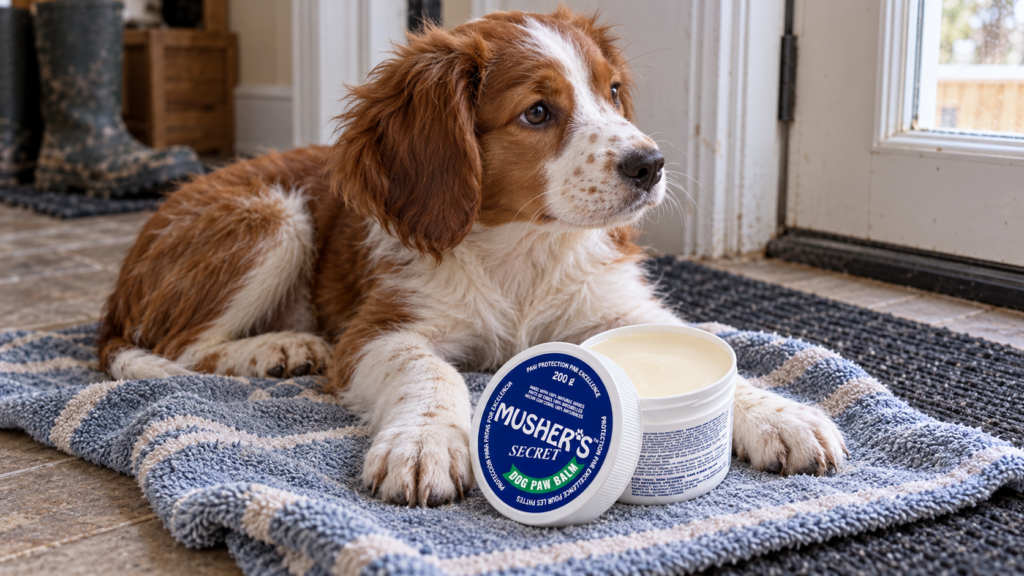
If you are standing in front of a shelf of dog paw balms and waxes, the tins look interchangeable, but they do opposite jobs. A barrier wax goes on before a walk to put a layer between the pad and salt, ice, or rough ground. A conditioning balm goes on afterward to soften pads that are already dry. Pick the wrong one and you get slippery floors, wasted product, or a sore paw that never quite improves.
Most dogs do fine without anything on their paws. Pads are thick, tough skin over a cushion of fat, and on ordinary walks they look after themselves. Winter changes that for some dogs, and paw care is one part of keeping a dog safe outside in cold weather. Road salt, freezing slush, dry indoor heat, and sharp trail gravel can dry out the surface and open small, painful cracks. So the useful question is whether you are protecting healthy pads before a walk or helping dry pads recover afterward.
What Paw Wax and Paw Balm Each Do
Barrier waxes use waxes such as beeswax, carnauba, or candelilla, which sit on the surface and shed water. Conditioning balms rely on oils and butters that soak into dry keratin, the tough protein in the outer layer of the pad. The difference matters in practice, because a light moisturizer washes off quickly in salty slush and a dense wax on a deeply cracked pad does little to soften it.
A healthy pad needs to be tough and still flexible. Soften it too much and it can tear more easily on sharp ground. Let it dry out and small surface cracks widen every time your dog puts weight on that foot, which is when they start to hurt. Pads are working skin (they even contain sweat glands), so a thin layer is all you need. A thick coating mostly ends up on your floors or in your dog’s mouth.
Musher’s Secret: A Barrier Wax for Salt, Snow, and Rough Ground
Musher’s Secret Dog Paw Protection Wax was originally developed in Canada for sled dogs, and it is the one I would reach for before a salty or snowy walk. The wax is firm in the tin and softens with the warmth of your fingers. Rubbed over the pads and between the toes, it settles into the surface grooves and reduces direct contact with salt, rough pavement, wet snow, and coarse trail grit.
Snow is where it earns its keep. Snow that packs into the fur between the toes can freeze into hard lumps, which is why sudden lameness on a winter walk can come from ice packed between the toes as well as from an injury. The wax makes it harder for snow to stick, and keeping the hair between the toes trimmed helps even more. On rough trails a thin layer before the hike cuts down on scuffing, and wax pairs naturally with winter coats for cold weather walks when the whole outing is cold.
Salted sidewalks are where a wax runs out of protection. It puts a layer between the pads and the de-icing chemicals, but it does not replace wiping the feet afterward. Wipe or wash the feet, legs, and belly to remove de-icers and other chemicals that can be toxic, and a dog paw cleaner makes that rinse quicker. For very salty routes, or a dog whose pads are already sore, well-fitted booties give more coverage than any wax.
Natural Dog Company Paw Soother: A Softening Balm for Dry, Cracked Pads
Pads that are already rough, peeling, or thickened need softening more than shielding. Natural Dog Company Paw Soother Balm is a softer balm made for that job. It works best at bedtime or after a walk, on pads whose edges feel stiff, dry, or flaky, because your dog is resting while the oils soak in. On trail routes it is the recovery step rather than the preparation.
Older dogs are the other group worth mentioning. Some develop thick, crusty buildup on the pads called hyperkeratosis. The word comes from the Greek hyper, “over,” and keras, “horn.” Regular moisturizing is part of how it is managed, but have your veterinarian look at thick, crusty pads before you treat them at home.
Apply balm after the last walk of the day rather than before a trip across a slippery hardwood floor, since a freshly greased pad grips less. If a salted walk left the pads dry, that evening is when to condition them.
At a Glance: Barrier Wax vs. Conditioning Balm


How to Apply Paw Wax and Balm Without Mess or Licking
Clean and dry the paws first, because either product spread over grit or salt traps it against the pad. Then use less than you think: warm a pea-sized dab between your fingers and work it into the main pad, the toe pads, and the fur between the toes.
Whichever you choose, use a product made for dogs, because anything on a paw tends to get licked. Human diaper-rash creams and sunscreens often contain zinc oxide, and licking off a zinc oxide cream can cause vomiting and diarrhea. Repeated licking of a cream applied to the skin can also damage red blood cells.
The two products differ on licking. Barrier wax goes on at the door, and once your dog is walking and sniffing, licking is the last thing on their mind. Evening balm has no walk to distract from it, so give your dog one. A chew or lick mat for several minutes usually covers the gap, and safe dog chew toys are the ones to stick with. For very dry pads, a clean cotton sock for 10 to 15 minutes protects the furniture while the balm soaks in, with you nearby so it does not end up chewed or swallowed.
When a Wax or Balm Is Not Enough
Warm pavement is different, because waxes cannot prevent burns on dangerously hot asphalt. If the ground is too hot for your hand, shift walks to cooler hours.
Balm is for dryness, not damage. A pad cracked deep enough to bleed deserves a closer look. So does a limp that does not settle once any ice is cleared from between the toes, or a dog who keeps licking one foot. Signs like the ones below can point to infection, foreign material, interdigital cysts, allergic disease, or another problem that needs veterinary care.
- 01
Open puncture wounds
Paw waxes and balms are not for broken skin.
- 02
Deep bleeding cuts
A cut that bleeds needs care, not a coating.
- 03
Torn nails
A torn nail is an injury, not dryness.
- 04
Swelling, foul odor, or discharge
These go beyond routine outdoor wear and chapping.
- 05
Raw skin between the toes
Balm is for superficial dryness, and raw skin is past that.
- 06
Persistent limping
A limp that carries on after the walk needs a look.
Buy the tin that matches the problem you keep running into: winter salt and packed snow call for a wax, and stiff, flaky pad edges call for a balm.
This article is for educational purposes only and is not a substitute for professional veterinary care. Always consult a licensed veterinarian regarding your pet’s health and nutritional needs. As an Amazon Associate, Vet Explains earns from qualifying purchases.
Was the article helpful?