
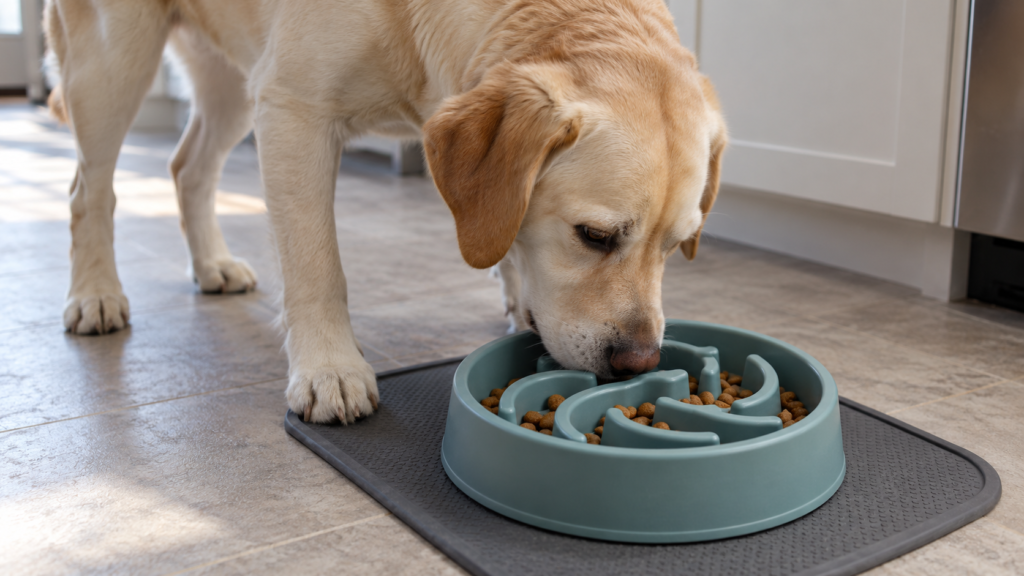
A slow feeder bowl is one of the few pet products that does the thing printed on the box. In a small trial of 10 pet dogs, a go-slow bowl clearly cut how fast the dogs ate. So if your dog empties a bowl in under a minute and then gags or brings the meal straight back up, the answer is yes, get one.
The longer answer matters more. These bowls are marketed on bloat prevention, the one claim the evidence does not support, and dogs speed up again as they get used to the bowl. Both are worth knowing before the bowl becomes the whole plan.
Why Some Dogs Empty the Bowl So Fast
Fast eating is usually instinct, not a behavior problem. Dogs that once competed with littermates, other pets, or genuine scarcity carry that urgency into adulthood, even where food has never been short. A second dog in the house adds speed too, because dogs guard resources when another animal is nearby, even a calm housemate with no interest in their bowl.
Appetite is partly genetic. Labrador retrievers and flat-coated retrievers often carry a deletion in the POMC gene linked to greater food motivation. Body shape matters for a different reason: large, deep-chested breeds are the dogs in whom fast eating carries the most risk, and that is why bloat comes up again below.
What a Slow Feeder Actually Fixes
The everyday problem with gulping is regurgitation (from the Latin regurgitare, to flood back), where a dog brings up undigested food within minutes of eating. It usually just means food and air went down faster than the esophagus could move them along. Gulping without chewing also sends larger pieces down whole, which occasionally leads to choking or an obstruction.
A slow feeder interrupts the mechanics. These bowls use raised ridges, knobs, or a maze-like pattern molded into the base, so your dog eats around the obstacles instead of scooping up mouthfuls in one motion. Most are hard plastic or food-grade silicone. Plastic holds up better under heavy chewers. Silicone is lighter, dishwasher and microwave safe, and a bit gentler on the nose.
The goal is not to turn dinner into a struggle. A good slow feeder makes the mouthfuls smaller, and a slower, steadier meal is the realistic result, not one that drags on.
Picking the Pattern, Not the Brand
Match the bowl to your dog’s size and how they eat. A tiny maze can frustrate a large, food-driven dog into muscling through it anyway, while a pattern that is too shallow will barely slow a small dog down.
Wet food and small kibble suit a shallow ridge pattern, since deep mazes are hard to clean out. If you feed wet food or a mix, check the bowl is labeled dishwasher safe. If you are still weighing wet food against dry, settle that first, because it decides which pattern you need.
Both bowls below use a raised-obstacle design rather than a simple divider, which slows most dogs more effectively.


Product prices and availability are accurate as of the date/time indicated and are subject to change.
The Outward Hound Fun Feeder is the most widely used slow feeder on the market, in several sizes and patterns, so sizing up or down is easy. The Bifeaw bowl is a lighter silicone alternative, dishwasher and microwave safe, which some owners prefer for daily cleaning. Neither needs filling to the top, and a lower fill level slows eating further if your dog still finishes too quickly.
Watch the first few meals with any new bowl. A small number of dogs get discouraged and eat less, and a shallower pattern usually solves that. Then look again a few weeks later, because dogs get faster with practice. In the same small trial, dogs with experience of the go-slow bowl ate from it more quickly than at first.
What Slow Feeders Can and Cannot Do About Bloat
The reason these bowls get marketed so hard is bloat, properly called gastric dilatation-volvulus (GDV) (volvulus comes from the Latin volvere, to twist), where the stomach fills with gas and can twist on itself. It is an acute, life-threatening emergency, and roughly 20 to 30 percent of treated dogs still die from it. Once-daily feeding, feeding dry kibble alone, rapid eating, and a deep, narrow chest are all associated with GDV.
Rapid eating sits on that list, which is where the sales pitch begins. But a review of six studies on eating speed and GDV found the evidence mixed, and most showed no clear effect. The reviewers concluded something narrower: slowing a dog down will not raise GDV risk and may lower it. That is a good reason to use a slow feeder, but it is not a guarantee against bloat, and I would rather nobody bought one thinking the problem was handled.
The habits with better support behind them are duller. Splitting one large meal into two or three smaller ones is the main one, because once-daily feeding is one of the feeding habits repeatedly linked to bloat. Before dividing meals up, work out the right daily total, which is its own question: how much to feed a dog. Keeping hard exercise, rough play, and other excitement away from mealtimes helps too, for at least an hour before a meal and two hours after it. That matters most in large or deep-chested breeds, and is a sensible precaution rather than a proven preventive.
If enrichment is the goal, puzzle feeders and snuffle mats add mental work on top of the physical slowing and make a good rotation option, and safe chew toys are worth adding. Hand-feeding part of the meal can help anxious or resource-guarding dogs reset the pace.
When This Stops Being a Feeding Problem
Occasional regurgitation after a fast meal is common and usually not an emergency on its own. A distended, hard belly, unproductive retching, restlessness, and collapse are a different story entirely, and not a feeding question.
Call your vet or an emergency clinic immediately if you notice: a swollen or hard abdomen, repeated unproductive retching (trying to vomit with nothing coming up), restlessness or pacing, heavy drooling, pale gums, weakness, or collapse. These are signs of possible bloat or GDV, which can become fatal within hours. Dogs seen more than six hours after signs begin are less likely to survive, so do not wait to see if it resolves on its own.
If you are unsure which you are looking at, ask whether your dog seems comfortable. One that brought a meal back up and then went back to being a dog is usually fine. One that cannot settle, keeps retching without producing anything, and has a belly bigger than it was an hour ago is not, and needs a clinic tonight.
This article is for educational purposes only and is not a substitute for professional veterinary care. Always consult a licensed veterinarian regarding your pet’s health and nutritional needs. As an Amazon Associate, Vet Explains earns from qualifying purchases.
Was the article helpful?