Table of Contents
Periodontal disease is the most common health problem I see in adult dogs, and there is a good chance it has already started in your dog’s mouth. By the time a dog turns three, nearly eighty percent will have some form of it. It starts quietly. Soft plaque, a sticky film of bacteria, builds up on the teeth within hours of eating. Left undisturbed, that plaque can begin hardening into tartar within a single day. Once tartar forms along and under the gumline, bacteria work down into the space between the tooth and gum. That is what triggers the inflammation that slowly destroys the bone holding the tooth in place, and the tooth is eventually lost.
Many owners rely only on dental chews or water additives, but brushing is still the most effective thing you can do at home. Chews and rinses help clean the tops of the teeth, but only the friction of a brush reaches under the gumline, which is where the disease actually starts. Pairing brushing with an enzymatic toothpaste adds a second layer of protection: the toothpaste keeps working on bacteria even after you put the brush down.
Why At-Home Tooth Brushing Is the Gold Standard for Canine Oral Health
A dog’s mouth is home to hundreds of different bacteria. Left alone, they multiply fast on the tooth surface and build a sticky film, plaque, that shields them from saliva. Bacteria deep inside that film release toxins that irritate the gum tissue next to them. The body’s response to that irritation is gingivitis (from the Latin gingiva “gum” + -itis “inflammation”), which you will see as a red line right along the gumline.
Dogs rarely get cavities the way people do. Their real risk is periodontitis (from the Greek peri- “around” + odont- “tooth” + -itis “inflammation”), which attacks the tissue and bone anchoring the tooth in the jaw. Once that bone is gone, no amount of brushing will bring it back.
Brushing every day, or at least every other day, breaks up plaque before it can harden. Dental chews help too, but they mostly clean the tips and edges of the teeth. They rarely reach the base of the tooth near the gumline, especially on the big upper premolars and canine teeth, which is exactly where tartar builds up fastest. A soft-bristled brush is the only tool that reliably gets there. That is what keeps plaque from turning into the kind of tartar that eventually needs a professional cleaning under anesthesia to remove.
How Enzymatic Pet Toothpastes Break Down Plaque Biofilm
Never use human toothpaste on your dog. It contains foaming detergents, abrasive chalks, and often an artificial sweetener called xylitol. Xylitol is dangerous to dogs in very small amounts and can cause a life-threatening drop in blood sugar. Your dog also cannot rinse and spit, so whatever you put on the brush gets swallowed. That is why dog toothpaste is made to be non-foaming, safe to swallow, and flavored with things dogs actually like, such as poultry, beef, or vanilla mint.
The best veterinary pastes use two ingredients working together:
- Glucose Oxidase and Lactoperoxidase: These two enzymes work together to turn natural compounds in saliva into hypothiocyanite, a compound that interferes with how bacteria produce energy and slows plaque from sticking back onto clean enamel.
- Baking Soda: Many formulas also add baking soda (sodium bicarbonate) to neutralize acidic bacterial waste, lift surface stains, and cut down on odor without wearing away the enamel.
The enzymes keep working after you put the brush away. As your dog licks the leftover paste around their mouth, it spreads over the cheeks and gums and keeps fighting new bacteria for a while.
Choosing the Right Brush: Silicone Finger Brushes vs. Handled Bristles
Picking the right brush often decides whether brushing becomes a daily habit or a daily fight. There are two main styles, and the right one depends on your dog’s temperament and the size of their mouth:
- Silicone Finger Brushes: These slip over your index finger and replace a hard plastic handle with soft, flexible silicone bristles. Because the bristles cover the whole fingertip, you clean plaque off the tooth no matter which angle you touch it from. Dogs also tolerate a familiar finger far better than a foreign object, so finger brushes work especially well for puppies, small dogs, and anxious or head-shy dogs.
- Long-Handled Brushes: These have an angled handle with a large brush head on one end and a smaller head on the other, and they reach the back molars of medium and large dogs much better than a finger can. Because the handle keeps your fingers out of the dog’s mouth, this is the safer option for strong chewers.
A hybrid approach often works best. Start with a soft finger brush to build trust, then move to a long-handled brush once your dog is comfortable with you handling their mouth.
At a Glance: Top Veterinary-Recommended Canine Dental Products
Here is how the top products compare on what they do, who they suit, and what real owners say about them:
| Product | Design & Core Function | Active Mechanism / Materials | Best Suited For | Typical Price & Ratings |
|---|---|---|---|---|
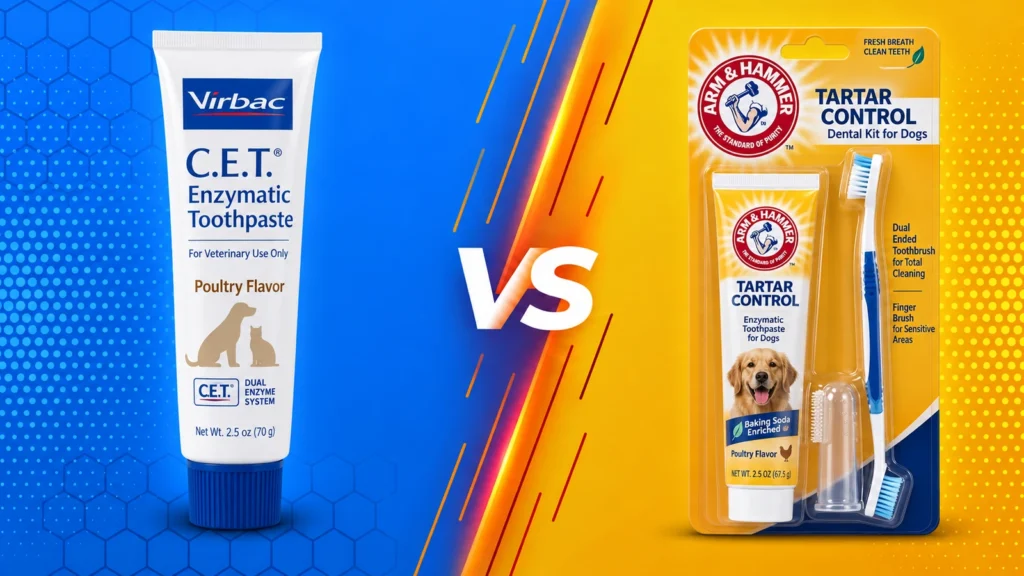
| Virbac C.E.T. Enzymatic Toothpaste (Poultry Flavor) | Standalone enzymatic paste for daily plaque control at the gumline | Dual-enzyme system (glucose oxidase, lactoperoxidase), no foaming agents | All dog sizes; dogs requiring powerful biofilm inhibition without swallowing risks | ~$12.29 – $14.95 (4.7/5 stars, 10,000+ reviews) |
| Jasper 360-Degree Silicone Finger Toothbrush (2-Pack) | Patented multi-directional finger brush with surround bristles | 100{903c3660f17f680c56e7423970c8f2be31eb3846c815fe49e8191c180aea948e} medical-grade, BPA-free silicone with 360-degree soft micro-bristles | Puppies, small dogs, brachycephalic breeds, and pets that panic at rigid plastic handles | ~$13.99 (4.5/5 stars, 14,500+ reviews) |
| Arm & Hammer Tartar Control Dog Dental Kit | Complete 3-piece starter set (paste, dual-head brush, finger sleeve) | Sodium bicarbonate tartar control formula, dual-ended angled nylon brush | Beginners seeking an all-in-one starter kit for medium to large dogs on a budget | ~$10.13 – $12.93 (4.5/5 stars, 7,900+ reviews) |
A Step-by-Step Desensitization Protocol for Dogs That Resist Brushing
Trying to brush all forty-two teeth on day one is the number one reason owners give up on home dental care. A dog’s mouth is sensitive, and forcing it open triggers a fear response that undoes all your progress. Go slowly instead, and build the habit over one to two weeks:
- Days 1 to 3, Taste Introduction: Put a pea-sized dab of the enzymatic paste on your fingertip and let your dog sniff and lick it off. Do not touch their mouth yet. You are just teaching them that your hands mean something good.
- Days 4 to 6, Getting Used to the Lip Lift: While your dog licks paste off your finger, gently lift their upper lip with your other hand for two or three seconds, then praise them and let go. As they get comfortable, start sliding your paste-covered finger along the outside of their teeth.
- Days 7 to 9, Introducing the Brush: Put paste on a soft finger brush and let your dog lick the bristles first. Once they are relaxed, gently wipe the front teeth in small circles. Stick to the outside surfaces; your dog’s own tongue takes care of the inside.
- Day 10 and Beyond, the Full Routine: Work back toward the bigger teeth, lifting the corner of the lip while the jaw stays closed. Keep the whole session under sixty seconds. Follow it immediately with praise, play, or a meal in a slow feeder bowl to keep the routine feeling like a reward.
If your dog ever shows discomfort or pulls away hard, stop right there and go back to the previous step for two more sessions. Keeping each session short and stress-free matters far more than covering every tooth on any given day.
This article is for educational purposes only and is not a substitute for professional veterinary care. Always consult a licensed veterinarian regarding your pet’s health and nutritional needs. As an Amazon Associate, Vet Explains earns from qualifying purchases.
Was the article helpful?