
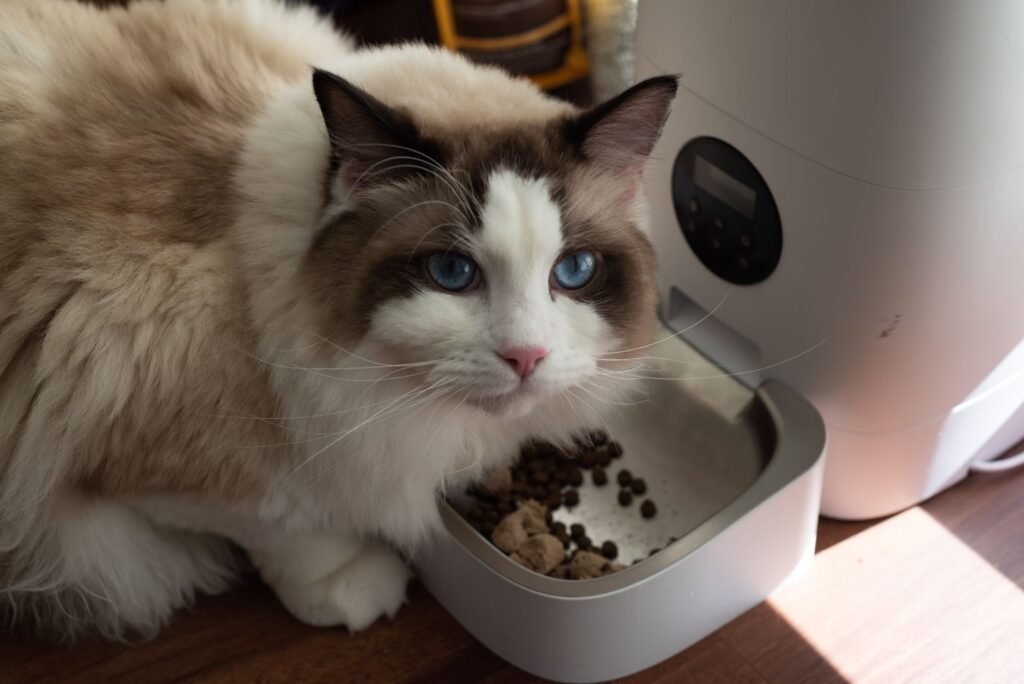
Maybe you are going away for a long weekend, or your shifts do not line up with dinner. A good automatic feeder solves two real problems. A bad one creates a third that nobody warns you about.
The two it solves are timing and portion size. A feeder that drops a measured amount at set hours lets a cat eat closer to the way cats are built to eat. It also stops the slow creep of a scoop you eyeball every morning. The third problem is worth keeping in mind while you shop. A machine cannot tell you the food was not eaten, and that is the most useful thing an owner notices.
Here are the three side by side. The sections below explain what a feeder does well, which type suits dry or wet food, and how to set it up.


Product prices and availability are accurate as of the date/time indicated and are subject to change.
What an Automatic Feeder Is Actually Good At
Start with cats, because the design suits them better than it suits dogs. Cats naturally eat many small meals through the day and night. The advice for pet cats is to split the daily ration into at least five portions across the full 24 hours, using timed and puzzle feeders to help. Two bowls, morning and evening, is a human schedule. A timer closes that gap without an alarm at three in the morning.
The second thing these machines do well is keep portions steady. Cats with food available all day can eat more than they need and gain weight. Dogs are the same, and the cost is not just about looks. Overweight dogs have a higher disease risk, including cancer, diabetes, heart disease, high blood pressure, arthritis and bladder stones. Being even moderately overweight can shorten a dog’s life by nearly two years. A portion measured by a machine does not creep.
Third, the feeder takes over the begging. The cat who used to yell at you at five in the morning starts yelling at the feeder instead, and then stops. The feeder does not negotiate.
Dry, Wet, and the Feeder You Can Trust With Each
Almost every automatic feeder sold is a kibble hopper, and that quietly shapes what ends up in the bowl. Most healthy cats do better on a mix of wet and dry food than on either alone. A dry-only machine nudges a home toward kibble, because kibble is all it can handle. The same wet versus dry question comes up often with dogs.
If your cat eats wet food, you need a different kind of feeder. It is a tray of sealed compartments on a timer, usually with a slot for a frozen ice pack underneath. These keep a portion safe through a working day, not a weekend away. That is a real limit of the design, not a fault.
Rule out gravity feeders before you spend anything. They are a hopper that refills the bowl whenever it empties, which is free feeding with extra plastic. For a lean adult cat with a sensible appetite, that is fine. If portion control is why you are shopping, a gravity feeder will undo the very thing you are trying to fix.
What to Check Before You Buy
Jamming is behind most one-star reviews, and it is usually a mismatch rather than a fault. Kibble that is very small, very large, oddly shaped or semi-moist can block the opening of a hopper designed for round kibble about 10 millimeters (0.4 inch) across. Check the feeder’s kibble size range against the food you actually buy. Look for a stirring paddle or an anti-jam design rather than a plain gate.
Then run through a few quick checks. How small is the smallest portion? A 4 kg (9 lb) cat eating five meals a day needs small amounts that a big dog feeder cannot measure. Does it keep time through a power cut? In practice that means batteries as well as the plug. Is the bowl stainless steel, or at least removable? Plastic holding oily kibble residue goes rancid. And how loud is the motor? A nervous dog may decide the clicking means something bad is coming.
For two pets you have two options, and they are not equal. One hopper with a splitter and two bowls works when both pets eat the same food in the same amounts. If one cat bullies the other away from the bowl, you need two machines in two separate rooms, or a feeder that opens only for one pet’s microchip.
Three Feeders Worth Buying
One straightforward timed feeder for a single pet, one built for two, and one that handles wet food.
The VOLUAS is the simple, high-capacity choice for one cat or a small dog. It has a 4 liter (about 17 cup) hopper, up to four meals a day, and portions small enough to split a cat’s daily ration properly. Four meals is one short of the five described above, so hold back a small part of the daily ration for a puzzle feeder or a bedtime hand feed. It keeps its schedule through a power cut, and a 10 second voice recorder plays your own call to dinner. Its rating sits a little below the others. Almost all of the reviews pulling it down are jamming reports from owners using unusually small or large kibble.
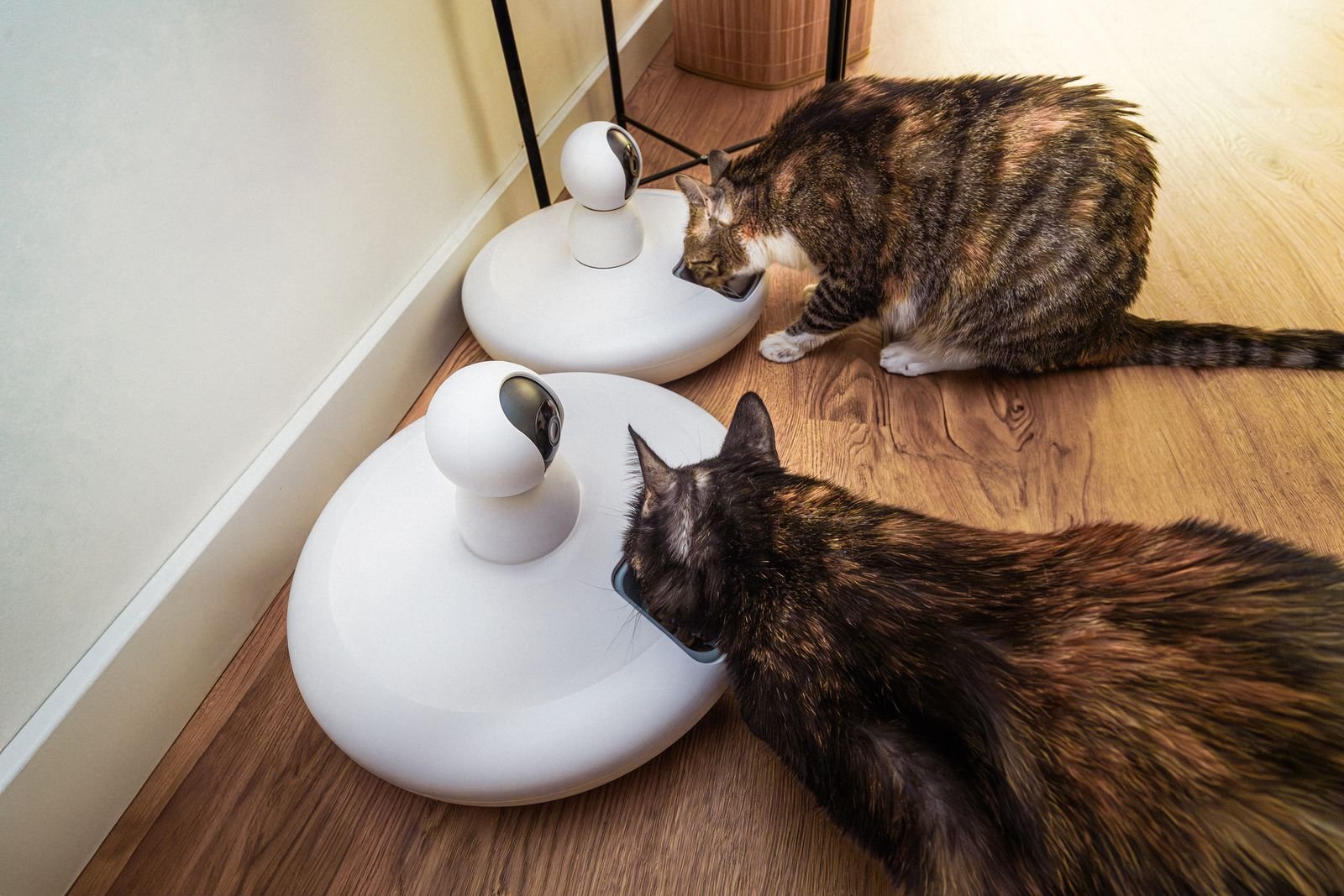
The oneisall is the one I would pick for two cats on the same food. Its 5 liter (about 21 cup) hopper splits each portion between two stainless steel bowls on one tray. Both cats eat at the same moment, instead of racing for whichever bowl filled first. It handles dry food only, and it will not fix a real bullying problem. For two easygoing cats, though, it halves the hardware.
The Cat Mate 2-Meal is the answer when your cat eats wet food. It has two compartments on a timer, with a reusable ice pack to keep the food cool, and you can set both meals up to 48 hours ahead. Two meals is its limit, so it suits a cat fed twice a day rather than five small portions. The ice pack buys a long day, not a weekend. Almost nothing else at this price does the job at all.
None of the three is built for a medium or large dog. A 65 lb dog can eat 3 to 4 cups of kibble a day, which empties these hoppers in about five days, and their portions are too small for a full meal. For a bigger dog, look for a larger hopper, a maximum portion that covers a full meal, and a heavy or lockable base. A determined dog will tip a light feeder to get at the food.
Setting It Up So It Does Not Backfire
The most common mistake is adding the feeder instead of replacing the old routine. Weigh the daily ration once, divide it by the number of meals you set, and then stop feeding by hand. A feeder running alongside the old routine is just extra food. If weight loss is the goal, set the portion and meal times with your vet rather than guessing.
Run the feeder for a week while you are still at home before you rely on it for a trip. Watch for three things. Does the portion match what the display claims? Does your pet eat from it without hesitating? Does it jam on the food in your cupboard?
In a multi-cat home, where the feeders go matters more than which feeder you buy. Ideally each cat has two or three feeding and water spots in separate places. Cats generally do not like to share bowls, or to be watched by another cat while they eat. Two feeders at opposite ends of the house beat one clever feeder in the kitchen.
There are two things a feeder does not do. It does not handle water, and a cat drinking too little is a bigger problem than a cat eating at odd hours. A water fountain earns its place beside it. It is also not enrichment, because a feeder on a clock asks nothing of your pet. A puzzle feeder for part of the ration, or a slow feeder bowl for a dog who inhales dinner, does what a timer cannot.
When an Automatic Feeder Is the Wrong Answer
A feeder is not a pet sitter. It drops food into an empty room and tells you nothing, which is the opposite of what you need when you are watching appetite. A cat with kidney disease or hyperthyroidism, or any pet whose weight is being tracked, needs a person noticing how much was eaten. If you are away, a pet camera aimed at the bowl turns a feeder into something that tells you what happened.
Pets on insulin are the clearest case for keeping a person involved. Some cats being treated for diabetes need their meals timed with injections, and a missed meal can cause low blood sugar. The feeder can carry the schedule, but not the responsibility. The same goes for a dog on insulin.
Then there are dogs. A determined chewer treats a full hopper as a puzzle with food at the end. A dog with resource guarding around the bowl can get worse, not better, when food appears from a fixed spot he can stand over. A timer does not help a dog with separation anxiety either. The problem is your absence, and dinner on schedule does not change that.
The emergency here is the meal that did not get eaten, and an automatic feeder is very good at hiding it. A cat who skips meals altogether needs a call to your vet that day. Eating noticeably less for three days or more needs urgent vet attention, because cats cope badly with even short spells of eating less. If you come home to a full bowl, call your vet rather than putting it down to a fussy phase. For a pet on insulin the window is far shorter, because a skipped meal after an injection can drop blood sugar too low. Hypoglycemia (from the Greek “hypo,” meaning under, + “glykys,” meaning sweet, + “haima,” meaning blood), or low blood sugar, looks like wobbliness, weakness, confusion or a seizure. A pet showing those signs needs food and a vet straight away.
This article is for educational purposes only and is not a substitute for professional veterinary care. Always consult a licensed veterinarian regarding your pet’s health and nutritional needs. As an Amazon Associate, Vet Explains earns from qualifying purchases.
Was the article helpful?