
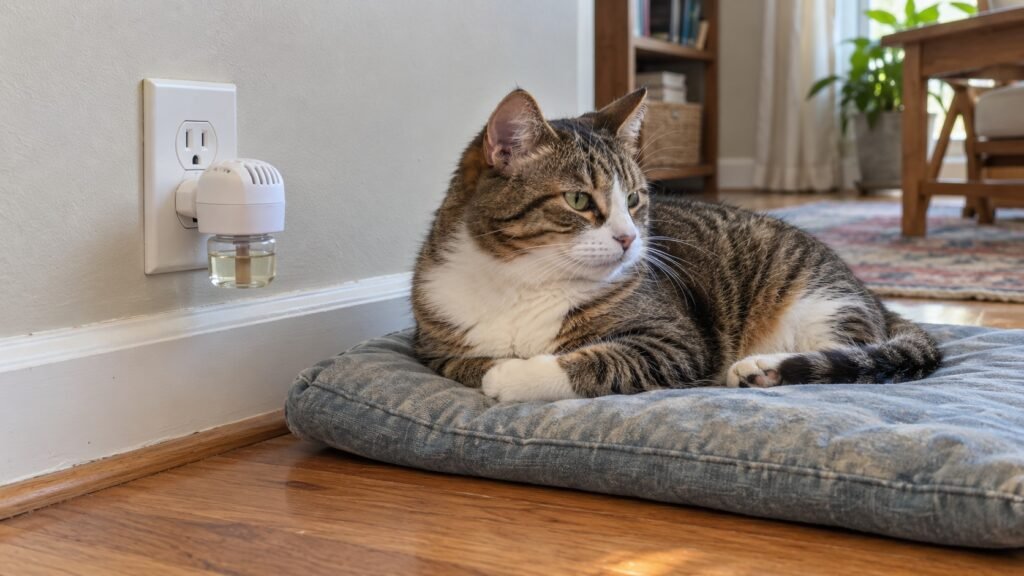
Your cat has started spraying the wall by the back door. Or she has hidden under the bed since the new kitten arrived, or she yowls whenever guests fill the living room. A plug-in diffuser promises to settle all of it, and you are wondering if it is a real product or a $30 air freshener for cats.
It is a real product with real limits. Synthetic pheromones are used in cats for spraying and marking, tension between cats, stressful events and separation anxiety, and plenty of cats do settle on them. A diffuser cannot make a crowded house less crowded, though. It also cannot replace the exam that rules out a medical cause. The plug-in is the easy half of the fix. Much of the half that decides whether it works is free.
Here are the five side by side. The sections below explain which product matches your cat’s problem and how to get a diffuser to work.


Product prices and availability are accurate as of the date/time indicated and are subject to change.
What a Pheromone Diffuser Actually Does
Cats rub their cheeks on door frames, chair legs and your shins, and each time they leave a scent mark. The message is roughly “this place is familiar and safe.” It comes from the feline facial pheromone, and these products are synthetic copies of it. A diffuser warms the liquid and releases it slowly. A room your cat feels uneasy in starts to smell like one she has already claimed.
That tells you what it can and cannot change. A diffuser lowers the background tension in a space. It will not settle a fight between two cats over one litter box, and it cannot explain that the stranger in the kitchen is your sister. These products are not medicines and do not treat disease. They are a tool for the home, and they work best alongside the changes in the last section.
Expect gradual rather than dramatic. Some cats settle within the first couple of weeks, while a cat spraying daily may spray less rather than stop. Give it a full month of correct use before deciding it has failed.
Rule Out a Medical Problem First
This is the part I would not skip. The most common reason a calming diffuser disappoints is that the cat was never anxious in the first place.
Peeing outside the box looks like a behavior problem, and very often it is not. A cat peeing in the house needs an exam and tests first. Bladder inflammation, kidney disease, thyroid disease and diabetes can all show up this way. So a cat who suddenly starts peeing in the house needs an exam before she needs a product. A urinalysis is usually the first test your vet asks for. In an older cat, chronic kidney disease and diabetes are both high on the list.
There is also a loop running the other way, which is what makes this confusing. Stress seems to play an important part in feline idiopathic cystitis (from the Greek “idios,” meaning one’s own, + “kystis,” meaning bladder), the most common form of feline lower urinary tract disease, or FLUTD. Common triggers are changes at home, changes to the feeding routine, and a pet joining or leaving the house. So stress really can cause bladder signs. That is why you cannot tell the two apart from the sofa.
Matching the Product to Your Cat’s Problem
There are three diffuser formulas on the shelf, and buying the wrong one is the second most common way this goes nowhere. They are not stronger and weaker versions of the same thing. Each one targets a different problem.
The classic single-cat formula is for a cat unsettled by her surroundings rather than by another cat. Think of a move, building work, a new baby, or a cat spraying in a one-cat home. The multi-cat formula uses a different pheromone, aimed at tension between cats who live together. Reach for it when the real picture is two cats staring each other down in a hallway. The newer Optimum formula is sold as covering both, and it is a sensible first pick when you cannot tell which problem you have.
Sprays are a separate tool, not a weaker diffuser. A spray treats one object, like the inside of a carrier, a blanket or the back seat of the car. Spritz a blanket in the carrier 15 to 30 minutes before you travel, rather than spraying your cat. If the whole problem is the twice-yearly vet trip, a spray and a better carrier routine beat anything plugged into a wall at home.
Five Calming Products Worth Comparing
Three diffuser kits for the three different problems, one spray for carriers and single objects, and one cheaper two-room kit for a house that needs more than one plug.
The Feliway Classic diffuser kit is the default for a single cat unsettled by her home, and it has the longest track record. The Feliway MultiCat kit looks almost the same on the shelf but is not interchangeable, so read the box. Feliway Optimum is the broader, newer option, and the one I would reach for when a home has several things going on at once.
The Feliway Classic spray earns its place even beside a diffuser, because it does a job a diffuser cannot. One bottle covers carriers, bedding and car trips for a long time. The Comfort Zone two-room kit is the budget route when coverage is the real problem. It comes with two diffusers and two refills for roughly the price of one premium kit.
Getting a Diffuser to Actually Work
Placement decides most of the result, and most people get it wrong by tucking the diffuser out of sight.
One diffuser covers up to about 700 square feet, and the outlet needs roughly four feet of clear space above it. Behind a door, under a side table, in a multi-plug adapter or on an extension cord are all the wrong spot. A two-story home needs more than one. Put it where your cat actually spends her day, which is often not the room where the problem shows up.
Timing is the other half. Replace the refill every four weeks even if liquid is left, and plug it in two or three days before an event you know is coming. Set the diffuser up a few days before the guests arrive, not on the morning they do. A cat already hiding behind the washing machine is one you are calming down, not keeping calm.
The Free Changes That Matter More Than the Plug-In
I would rather see an owner fix the home and skip the diffuser than buy the diffuser and change nothing else. Spraying is not spite. It is a coping strategy for anxiety and frustration, and social stress is more likely the more cats a home has.
The rule worth remembering is one of everything per cat, plus one spare, spread out rather than lined up in a row. That covers litter boxes in separate spots away from food and water, and beds, bowls, scratching posts, high perches and hiding places. Litter boxes belong somewhere quiet, private and easy to reach, which matters as much as the number. A second litter box, another water station and a tall scratching post often do more work than the plug-in.
Two smaller fixes punch above their weight. If your cat sprays near a glass door, cats outside are very likely the trigger, and frosted film over the lower glass removes it. A sprayed spot also needs an enzymatic cleaner rather than a household one. Enzymes clear the odor, while other cleaners leave just enough smell to invite a repeat.
One last thing is not a product at all. Enrichment can lower stress and reduce how often and how badly idiopathic cystitis flares up. That means safe places to pee, things to climb, interactive toys and a steady routine. Ten minutes of real play with a wand toy, twice a day, is a calming treatment. It just does not come in a box.
If the home is right and a month of diffuser use has changed little, talk to your vet next rather than the pet store. Calming supplements with ingredients like L-theanine or alpha-casozepine, a milk protein, have some research behind them and do not sedate your cat. For a cat who panics at the carrier or cannot settle in a multi-cat home, your vet can prescribe anxiety medication, for single events or longer term. That is a far better use of money than a fourth diffuser.
One situation in this article is not a stress problem and must never be treated as one. If your cat is straining in the litter box and passing little or no urine, stop working on the home and get to a vet now. That is urethral obstruction, a blockage that stops urine leaving the bladder. It is a true medical emergency. Male cats, including neutered males, are at higher risk because their urethra is longer and narrower. An untreated complete blockage can be fatal within 24 to 48 hours. The signs are repeated trips to the box, straining with only drops coming out, and a cat getting more distressed and vocal as the hours pass. No calming product helps here.
This article is for educational purposes only and is not a substitute for professional veterinary care. Always consult a licensed veterinarian regarding your pet’s health and nutritional needs. As an Amazon Associate, Vet Explains earns from qualifying purchases.
Was the article helpful?