
A good dog puzzle toy turns part of a meal into a small problem worth solving. That can be especially useful on rainy days, during recovery periods when exercise is limited, or for dogs that finish a bowl in seconds and immediately go looking for another job.
The best choice is not always the hardest puzzle. It is the one your dog can use safely, understand without becoming frantic, and enjoy often enough to justify the space it takes up. Size, chewing style, food type, cleaning, and difficulty matter more than a long list of moving parts. Of the two picks compared below, the Outward Hound Nina Ottosson Dog Brick suits dogs ready to slide, lift, and nose several compartments in one session, while the West Paw Toppl is the easier start for dogs that prefer licking and nudging.
How to Choose a Dog Puzzle Toy
Start with the way your dog naturally works. Some dogs use their nose and paws carefully. Others grab the entire toy, flip it, and chew whatever resists. A flat compartment puzzle rewards deliberate searching. A rubber food toy tolerates more licking, nudging, rolling, and gentle chewing. Neither style is automatically better.
Choose a toy large enough that your dog cannot swallow it or wedge it behind the teeth. Inspect hinges, removable covers, plugs, seams, and soft edges before every session. If pieces become loose, cracked, or sharply chewed, retire the toy. Puzzle toys are not indestructible chews, and dogs that bite hard at plastic may need the same precautions used when choosing safe dog chew toys.
Difficulty should leave room for success. Veterinary behavior guidance on foraging toys recommends considering the number of openings, compartments, and actions required to release food. More steps make a puzzle harder. A dog that paws, barks, bites the board, or walks away may be frustrated rather than enriched.
Also decide whether you want a puzzle, a slow feeder, or both. Sliding compartments encourage problem-solving in short sessions. Stuffable rubber toys can stretch a meal over a longer period, particularly when chilled or frozen. If the main problem is rapid eating rather than boredom, compare the shape and capacity with dedicated slow feeder dog bowls before buying.
Dog Brick vs. Toppl: Two Strong Picks
These products solve different versions of the same problem. The Dog Brick is a visible, multi-step puzzle with sliding lids and removable bone-shaped covers. The Toppl is an open rubber cup that can hold kibble, wet food, or a frozen mixture. One asks the dog to manipulate several parts. The other makes food take longer to reach.


Outward Hound Nina Ottosson Dog Brick
The Nina Ottosson Dog Brick fits dogs that already understand that moving a part can reveal food. Treats or kibble can go under the red sliding lids, inside the flip compartments, and beneath the white bone covers. That variety lets you simplify the board for a beginner, then add more covered spaces as the dog learns.
Its strength is choice. You can load only the easiest compartments for the first session and avoid turning every door into a test. Its main limitation is also obvious: multiple plastic parts create more edges for a frustrated chewer to target. Stay close, remove the board when the food is gone, and do not leave loose covers on the floor.
West Paw Toppl
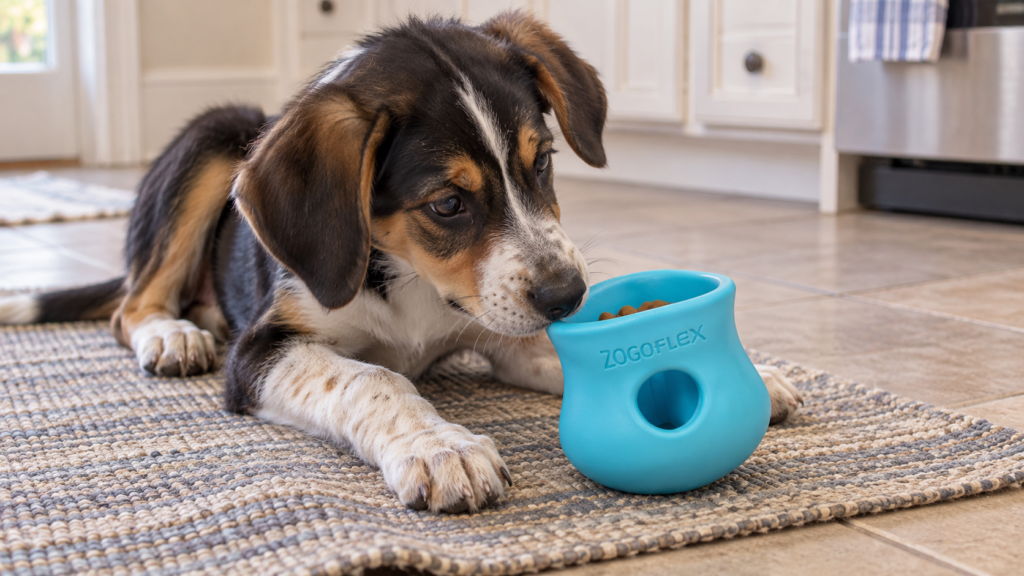
The West Paw Toppl is the gentler starting point. Its wide opening makes it easy for a dog to see and smell the reward, while the side hole and rounded shape keep kibble or soft food from disappearing all at once. It works well for dogs that prefer licking and nudging to lifting small puzzle pieces.
You can begin with dry kibble that falls out easily, move to a thin layer of canned food, and freeze only after the dog is comfortable. Pick the size based on your dog’s mouth and the amount of food you plan to use. A small toy may be convenient for a small dog, but it is not appropriate for a larger dog that can fit the whole item between the jaws.
Introduce the Puzzle Without Frustration
Make the first session almost embarrassingly easy. Let your dog watch you place a few pieces of kibble in open compartments or near the rim. Put the toy on a nonslip surface, step back, and allow sniffing. If your dog looks at you for help, point to or lightly move one part rather than completing the entire puzzle.
- 01
Use a familiar food
New equipment and new food at the same time can make it harder to tell what your dog dislikes.
- 02
Keep the first session short
End after a few easy wins, before pawing turns into frantic biting.
- 03
Increase one variable at a time
Add another covered compartment, pack the food more firmly, or chill the toy, but do not change everything at once.
- 04
Separate multiple pets
Food puzzles can trigger guarding even between dogs that usually share space peacefully.
- 05
Put the toy away when empty
That keeps it interesting and prevents a feeding tool from becoming an unsupervised chew object.
Food-based environmental enrichment can encourage foraging, slow eating, and keep pets mentally engaged. It should still fit the individual dog. A puzzle will not treat true separation anxiety in dogs, and it should not be used to delay a behavior or veterinary assessment when panic, self-injury, or escape attempts are present.
Use Food Safely and Keep the Toy Clean
The easiest way to prevent puzzle calories from quietly adding up is to measure the day’s food first and take puzzle portions from that amount. If you use treats instead, keep treats under 10% of daily calories unless your veterinary team gives different guidance. Dogs with food allergies, pancreatitis, diabetes, kidney disease, obesity, or a prescription diet need an individualized plan.
Avoid xylitol-sweetened peanut butter, chocolate, grapes, raisins, onions, garlic, and macadamia nuts, which are all dangerous foods to share with pets, and check anything unfamiliar against the fuller list of foods toxic to dogs. Fatty fillings can cause stomach upset and may be a poor choice for dogs with a history of pancreatitis, because a low-fat diet is central to managing that condition. When in doubt, use the dog’s usual complete diet rather than improvising with rich human foods.
Wash food-contact surfaces after each use. Follow the manufacturer’s directions for dishwasher placement, hand washing, and drying. Use a bottle brush for deep openings, check under moving parts, and discard food that has sat at room temperature long enough to spoil. A frozen toy buys time, but it does not make perishable food safe indefinitely.
Inspect the toy again while cleaning. Teeth marks that stay superficial may be expected, but splits, sharp ridges, stretched openings, or missing pieces are reasons to stop using it. If you cannot account for a broken piece, call your veterinarian for advice rather than waiting for vomiting or loss of appetite.
When Boredom or Reluctance Needs a Veterinarian
A sudden refusal to use a familiar puzzle can also matter. Dental pain, neck or back pain, nausea, vision changes, weakness, and cognitive changes in older dogs may make a once-enjoyable task uncomfortable. Notice whether the change is limited to one toy or appears with bowls, chews, stairs, walks, and normal meals too. A pattern is more useful to your veterinarian than assuming the dog has simply become bored.
This article is for educational purposes only and is not a substitute for professional veterinary care. Always consult a licensed veterinarian regarding your pet’s health and nutritional needs. As an Amazon Associate, Vet Explains earns from qualifying purchases.
Was the article helpful?