
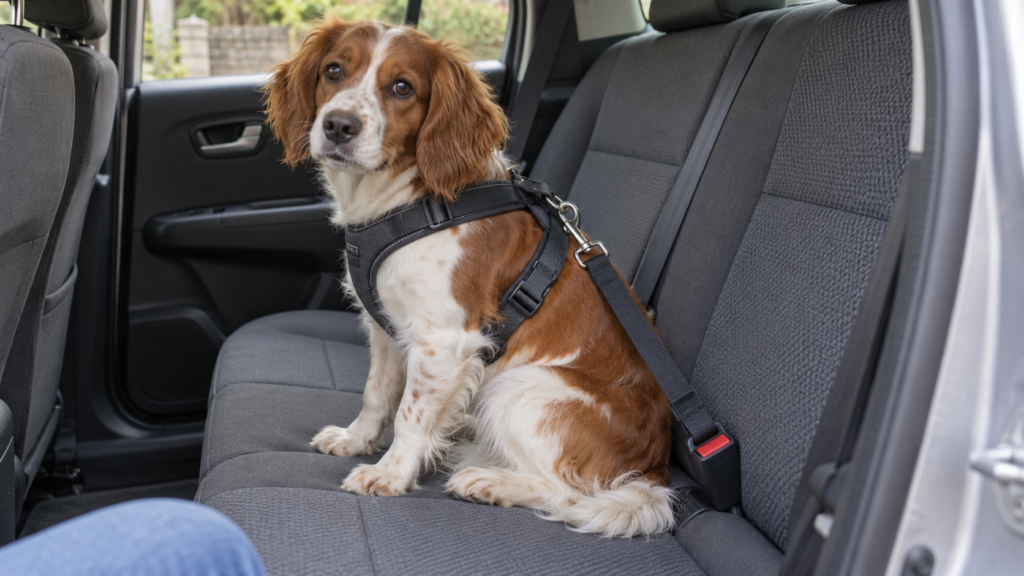
If your dog rides loose in the back seat, or you are shopping for a dog seat belt or travel harness, start with what happened when harnesses sold as crash protection were actually tested. Weighted, dog-shaped test dummies were strapped into them and sent down a sled track through a simulated 30 mph frontal crash. In that independent harness crash testing, most of them failed.
That result is the whole reason this purchase is confusing. “Crash-tested” gets used loosely in pet product marketing, and in the US there is no official performance standard for pet travel harnesses to be tested against. The closest thing to one is testing modeled on FMVSS 213, the federal standard originally written for child safety seats. So a product that cites an actual certification, a specific weight rating, and third-party test results is doing something meaningfully different from one that just says “safety” on the label.
So the useful question is not which dog seat belt is best. It is what the product in your cart is actually built to do.
What a Sudden Stop Does to a Loose Dog
The risk cuts two ways. In a collision, an unrestrained dog can be thrown through a window or crushed by a deploying airbag, and a dog carrying that much momentum is a danger to everyone else in the car too. A loose dog can also distract the driver by climbing into their lap, getting down by the pedals, or bolting through an open door at a stoplight or gas station.
None of it needs an actual collision. Hard braking alone, the kind that happens in ordinary traffic, is enough to throw an unrestrained dog forward off the seat.
Two groups pay more for that than the rest. A puppy who has never ridden in a car may already be anxious about the ride, and being tossed around on top of that can make future car rides much harder to manage. Senior dogs with joint pain or arthritis can be hurt by even a moderate jolt that a younger, healthier dog would shake off. For both, a secure, well-fitted restraint buys a steadier, more predictable ride as well as physical protection. Getting in and out is the other hard part for these dogs, and a ramp or a set of steps saves them the jump.
What Each of the Three Restraints Is For
There are three main setups, and they are not three grades of the same thing. A seatbelt tether is a short strap that clips between the car’s seatbelt buckle, or a buckle-style anchor, and your dog’s harness. Its real job is keeping your dog on the seat and out of your lap. It is not crash protection, because a tether with slack in it lets a dog build momentum before the strap snaps tight. If you use one, set it as short as your dog can comfortably sit and lie down with.
A car harness is a step up: a padded harness built for car use that works with the car’s own seat belt, with reinforced attachment points. The better ones come with published crash-test results, which is the documentation worth paying for.
Crates and hard-sided carriers are the most restrictive option, and they work well for smaller dogs, or for dogs who settle better contained than tethered. One condition comes with them: a crate should still be secured to the vehicle itself, because an unsecured crate can become its own projectile in a hard stop.
Where It Still Goes Wrong
The most common mistake is not buying the wrong restraint. It is improvising one. Clipping a dog’s everyday walking leash to a seatbelt buckle is not a substitute for a proper tether or harness: a standard leash gives several feet of slack, so your dog can still be thrown forward into the dashboard or another seat before the leash goes taut.
Retractable leashes are worse. The cord can lock unpredictably, or fail to lock at all, under sudden force, and the thin cord itself can cause a bad rope-style burn if a panicked dog pulls hard against it. A short car tether made for the job is inexpensive enough that there is not much reason to improvise with gear meant for sidewalk walks. If you fix one thing after reading this, I would make it that habit.
Fit is the other way good gear fails. A harness or tether that is too loose lets a dog slip partway out during a hard stop; one that is too tight restricts breathing or chafes at the armpits. Clip any tether to a harness, never a collar, because a sudden stop puts the full force on whatever the strap is attached to and a collar concentrates that force on the neck. On a car harness, check that the straps sit flat against the body with no twisting, and that you can comfortably fit two fingers between the strap and your dog.
Then there is the dog’s own opinion. Some dogs fight a new harness or tether at first, especially if they are used to having the run of the back seat. Start with short trips, a drive around the block rather than a two-hour haul, and pair the restraint with something positive, like a favorite chew or a trip somewhere fun. Letting your dog wear the harness inside the house for a few minutes first means the car is not the first time they feel it. Many dogs settle into the routine after a handful of short rides, and a few need longer.
Two Options, and What Each One Buys
These two sit at different points on the spectrum: an inexpensive everyday tether, and a harness sold with crash-test documentation behind it.


Product prices and availability are accurate as of the date/time indicated and are subject to change.
Both do a real job, and which one to buy comes down to how you use the car. Short errands mostly need to keep your dog from climbing around or bolting out an open door, which the COOYOO tether handles cheaply. Treat it as a convenience restraint, not crash protection, and because its strap is adjustable and has some stretch, keep it set short.
Regular long drives are a different problem. Bring a portable water bottle along, and if documented crash protection matters to you, EzyDog’s harness is the pricier but meaningfully different option. EzyDog publishes its own crash-test results for small, medium, and large dogs. That is the manufacturer’s testing and not an independent certification, so read it the way you would any company’s claim.
The Two Dangers No Restraint Touches
Restraints address impact and distraction risk. Two other car-related dangers are left over, and neither is solved by better gear.
Never leave a dog alone in a parked car, even briefly and even with windows cracked. Cracking a window makes no real difference to the heat. The inside of a parked car can climb about 20°F in the first 10 minutes, and more than 40°F above the outside temperature within an hour. A mild-feeling day outside can still turn dangerous fast. Go to the vet immediately if a dog shows signs of heatstroke such as heavy panting, drooling, vomiting, wobbliness, or collapse after time in a car. The same urgency applies after even a minor collision, if a dog seems stiff, reluctant to move, or unusually quiet afterward, since hidden internal injuries are not obvious right away.
This article is for educational purposes only and is not a substitute for professional veterinary care. Always consult a licensed veterinarian regarding your pet’s health and nutritional needs. As an Amazon Associate, Vet Explains earns from qualifying purchases.
Was the article helpful?