
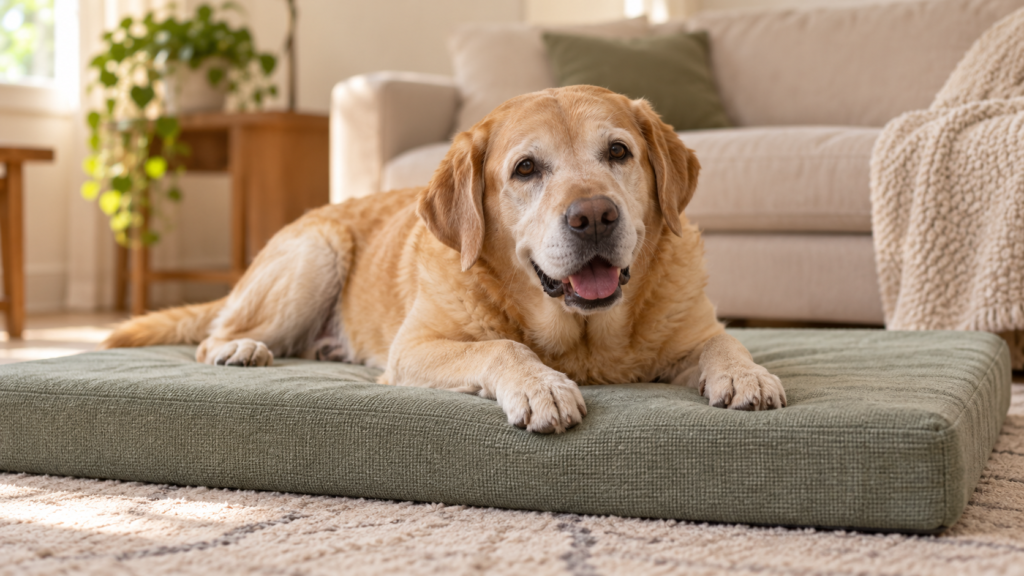
You have watched your dog circle the same spot three times, then lower herself down in two or three stages. Here is the short version. You want a solid core of real foam, at least four inches thick for a small or medium dog and six or seven for a large one, a cover that comes all the way off and goes in the machine, and a waterproof liner between the two.
Skip anything filled with shredded foam or polyester batting, whatever the listing calls it. It packs flat under a heavy dog within a season.
The reason to bother is that stiffness in an old dog is usually arthritis, and arthritis is a disease of the resting hours. In nearly half a million dogs in UK general practice, the median age at diagnosis of osteoarthritis in the limb joints was ten and a half years. Osteoarthritis comes from the Greek osteon, bone, and arthron, joint, with the ending -itis for inflammation. Dogs at or above their breed’s average weight carried more than twice the odds of being diagnosed, and Golden Retrievers and Labradors were both among the breeds at higher risk. Those are also the dogs that spend most of the day lying down, which is where the surface under them starts to matter.
What a bed cannot do is treat the arthritis. No mattress replaces weight control, pain relief, or an honest conversation with your vet about how far along your dog is. A good bed buys comfort in the hours she already spends on the floor, and it protects her elbows while she is there. That is worth paying for. It is not treatment.
What Makes a Bed Orthopedic, and What Just Says So
Orthopedic is not a regulated word on a pet product. It ends up printed on beds that are a sack of chopped foam with a zipper. Pick the bed up before you trust the label. If it folds easily in half, or you can press your fingers nearly through the middle, your dog’s hip will be resting on the floor through it by spring.
What you want is a single piece of foam, or a layered build with a firm base under a softer top. Thickness carries most of the benefit. Foam can only spread a dog’s weight if there is enough of it between bone and hard floor. Four inches is a sensible minimum under about fifty pounds. Large and giant breeds do better at six or seven, and that is the one place the expensive beds genuinely earn their price.
Density matters as much as thickness, and almost no listing tells you what it is. The usable test is how fast the foam pushes back after you press a fist in and let go. Good foam returns in a second or two; cheap foam holds the dent, and a dent is a thin spot.
Egg crate foam has a real place, though not the one the marketing suggests. For a dog who is down most of the day, a thick egg crate pad is what veterinary wound references recommend: the peaks and troughs let air move and stop any one patch of skin carrying weight for hours. For a dog who still gets up and putters around, a solid slab is the better buy.
Sizing, Height, and Where the Bed Goes
Measure your dog stretched out at her longest, nose to the base of the tail, and add six inches. Then watch how she sleeps: a sprawler needs the full length, a curler needs less floor and more depth. Buying a size up is almost never wrong.
Bolsters are where people choose badly. A raised rim looks cozier, and plenty of dogs like leaning a head against one. But it is one more obstacle for a dog whose back end is unreliable. For a dog with sore elbows, the rim is exactly where the elbow lands as she pushes herself up. A flat mattress, or a bolster along one side only, is easier to get on and off.
Total bed height is a step, and that cuts against thickness. A seven inch mattress sounds wonderfully supportive. It is also a seven inch step up for a dog who is already struggling to get up from the floor. If your dog has reached the point of needing a ramp or steps for the car, keep the bed low and firm rather than tall and plush.
Placement decides whether any of this gets used. Painful joints stiffen on cold, hard surfaces, and the bed on the tile floor by the back door is the one your dog walks past on her way to the carpet. Put it where the family sits and out of a draft. Something non-slip around it helps too, and secure footing with carpet runners is standard advice for arthritic dogs. A dog who expects her feet to skid stops lying down and getting up freely.

The Washing Problem Nobody Puts on the Box
Old dogs leak, and it is one of the less discussed parts of a dog becoming a senior. Some of it is incontinence, some is a dog who could not reach the door in time, and some is drool. Whatever the cause, the bed gets wet, and foam that gets wet does not really dry. It stays damp in the core, it smells within two weeks, and then you are buying the bed again.
So you want two layers between your dog and the foam. A cover that unzips completely and survives a machine wash, and a waterproof liner underneath that the foam never gets past. Check that the cover genuinely comes all the way off, because plenty of beds unzip along one edge and no further.
If the wetness is new, do not file it under old age and buy a liner. A dog who has suddenly started drinking far more than usual and leaking overnight is pointing at her kidneys, her blood sugar or a hormone problem. That deserves a urine sample at the vet rather than a mattress protector.
Getting an Older Dog to Use the New Bed
Dogs are conservative about where they sleep, and a new bed smells like a warehouse. Put it exactly where the old one was. Lay the old blanket on top for the first week. Feed a few meals beside it. Do not lift her onto it, which teaches her the bed is something that happens to her.
Give it two weeks. Dense foam feels firmer than a flattened old bed, and some dogs need a while to decide they like it.
If she still will not settle after two or three weeks, the bed is probably not what is wrong. Night pacing in an old dog can be canine cognitive dysfunction rather than discomfort, or pain that is not controlled well enough to let her lie still. Either one is a conversation with your vet, not a return label. And a few dogs simply want a cave rather than a mattress, in which case a den style bed is the honest answer.
Three Orthopedic Dog Beds Worth the Money
These three answer three different situations. The Big Barker seven inch memory foam mattress is what I would want under a large, stiff dog: flat, with no rim to climb, and thick enough to still be working in three years. The JOYELF memory foam bed is the sensible middle, with a bolster on part of the perimeter and a cover that comes off easily, and it suits a dog who likes something to lean on but can still step up. The EHEYCIGA waterproof bed is for the dog who has accidents, because the waterproof layer is built in rather than sold separately.


Buy for the dog in front of you, not the one in the product photo. A premium mattress is wasted on a thirty pound terrier, and a budget pad is a false economy under an eighty pound Labrador.
When the Bed Is Not the Problem
The change with the best evidence behind it is not a purchase at all. In obese dogs with arthritis, lameness improved measurably once they had lost between six and nine percent of their body weight. Keeping a dog lean across her whole life also slows how quickly arthritis progresses. No mattress competes with that. Joint supplements and the pain medication your vet chooses do the rest of the work.
Watch the pressure points while you are at it. Where a bony point presses into a hard surface for long enough, the small blood vessels in the skin collapse and the tissue over the bone dies, which is how decubital ulcers start. Decubital comes from the Latin decumbere, to lie down. Elbows, hips and the points of the shoulder go first, and heavy dogs on thin bedding go fastest. If you can already see a bald, thickened patch over an elbow, a better bed is part of the answer and a look from your vet is the other part.
A dog who has started limping on one leg rather than being generally stiff is asking a different question. Stiffness that is worse first thing and eases with movement fits arthritis. A single sore leg that appeared this week does not, and it is worth having examined.
Go to a vet immediately if your dog suddenly cannot stand, cannot place one or both back feet, or is dragging a back leg. That is not arthritis getting worse overnight. It is usually an intervertebral disc that has extruded into the spinal canal and is pressing on the cord, and in a review of 1,501 affected dogs the delay between the first signs and surgery was linked to how well they recovered. Those hours count, so do not wait for morning.
This article is for educational purposes only and is not a substitute for professional veterinary care. Always consult a licensed veterinarian regarding your pet’s health and nutritional needs. As an Amazon Associate, Vet Explains earns from qualifying purchases.
Was the article helpful?