
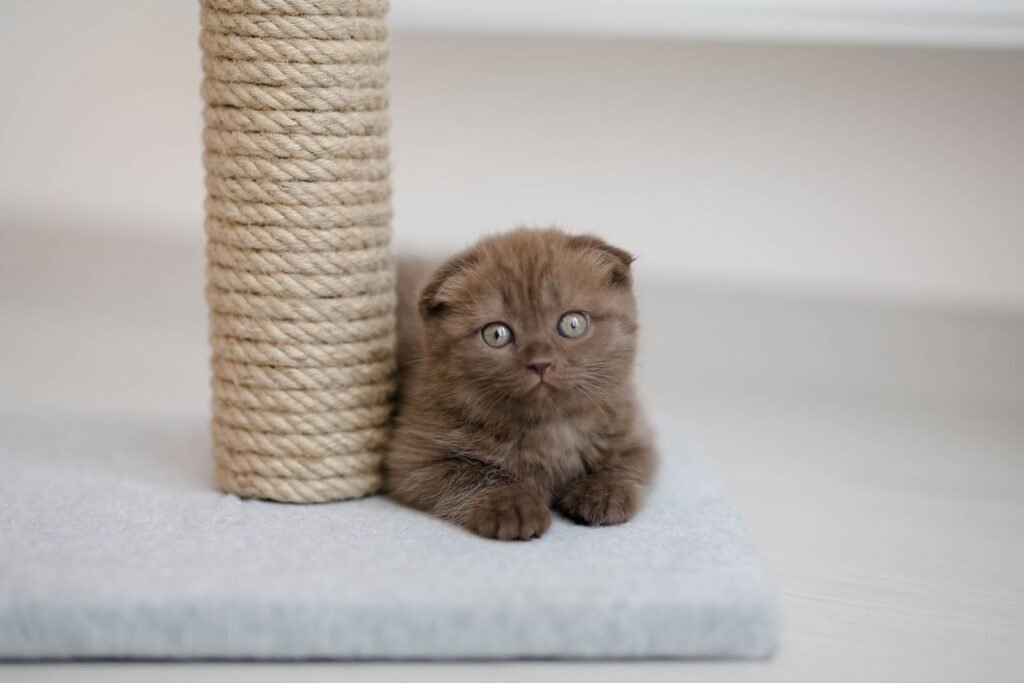
You have already repaired the arm of the sofa once and you are not doing it again. The good news is that a scratching post can fix this, as long as you buy the right shape and put it somewhere your cat actually goes. Scratching is not misbehavior and it is not a phase a cat grows out of. It is how cats keep their claws in working order and leave a mark other cats can see and smell. It also frustrates owners enough that some cats are given up over it.
The useful part is that your cat has already told you what they want. The material they chose, the angle they scratch at, and the room they chose to do it in are all information. Buying against that information is why the last post you bought is still standing untouched in the hallway. Get it right and the sofa stops being the most interesting thing in the room.
Why the Sofa Keeps Losing
Scratching does three jobs at once. It strips the worn outer sheath off the claws, stretches the whole front half of the cat, and leaves scent from glands between the toes. None of those needs disappears because you bought furniture you like, which is why the goal is never to stop the behavior. It is to give it somewhere better to go.
Punishment is the usual first move and the one that does not work. Among cat owners surveyed about this, the various deterrents and scoldings made no difference to how often cats scratched. A spray bottle teaches a cat to scratch the sofa while you are in another room, which is a harder problem than the one you started with.
Removing the claws is not the shortcut either. Cats who had the surgery were found to have higher odds of back pain, biting and house soiling than cats who kept their claws. Nearly two thirds of them had fragments of toe bone left behind. Onychectomy comes from the Greek onyx, “claw,” and ektome, “a cutting out,” and the name is honest about what the operation removes.
What Your Cat Has Already Told You
Start with the damage, because it is a shopping list. In that same survey, about five in six cats were scratching something their owner would rather they left alone. Chairs and other furniture were the most common target, with carpet close behind. Fabric and carpet were worked on more than any other material, which matters, because a bare sisal post feels nothing like either of them.
So look at what your cat picked. A cat grinding away at the side of an armchair is asking for something upright, firm, and tall enough to stretch into. A cat who shreds the carpet by the bedroom door is asking for something flat or gently angled, on the floor, where they already lie down. Buying the opposite shape is the single most common reason a new post gets ignored.
If you genuinely cannot tell which your cat prefers, start upright. The same survey found that cats used standing posts more often than flat scratch pads. An unused post is also a more expensive mistake than an unused pad.
Height, Grip, and the Wobble Test
Three things decide whether a post earns its place, and price is not one of them.
Height comes first. Your cat should be able to reach up, hook in, and stretch the full length of their back with their hind feet still on the floor. A post that stops at shoulder height gives none of that stretch, and the stretch is half the appeal. Measure your cat along the sofa arm they have been using and buy taller than the mark.
Stability comes second. Lean on the top of the post with the weight of your forearm. If it rocks, your cat will feel exactly that on the first hard pull and will not come back to it. A wide, heavy base does more for this than a thick post does.
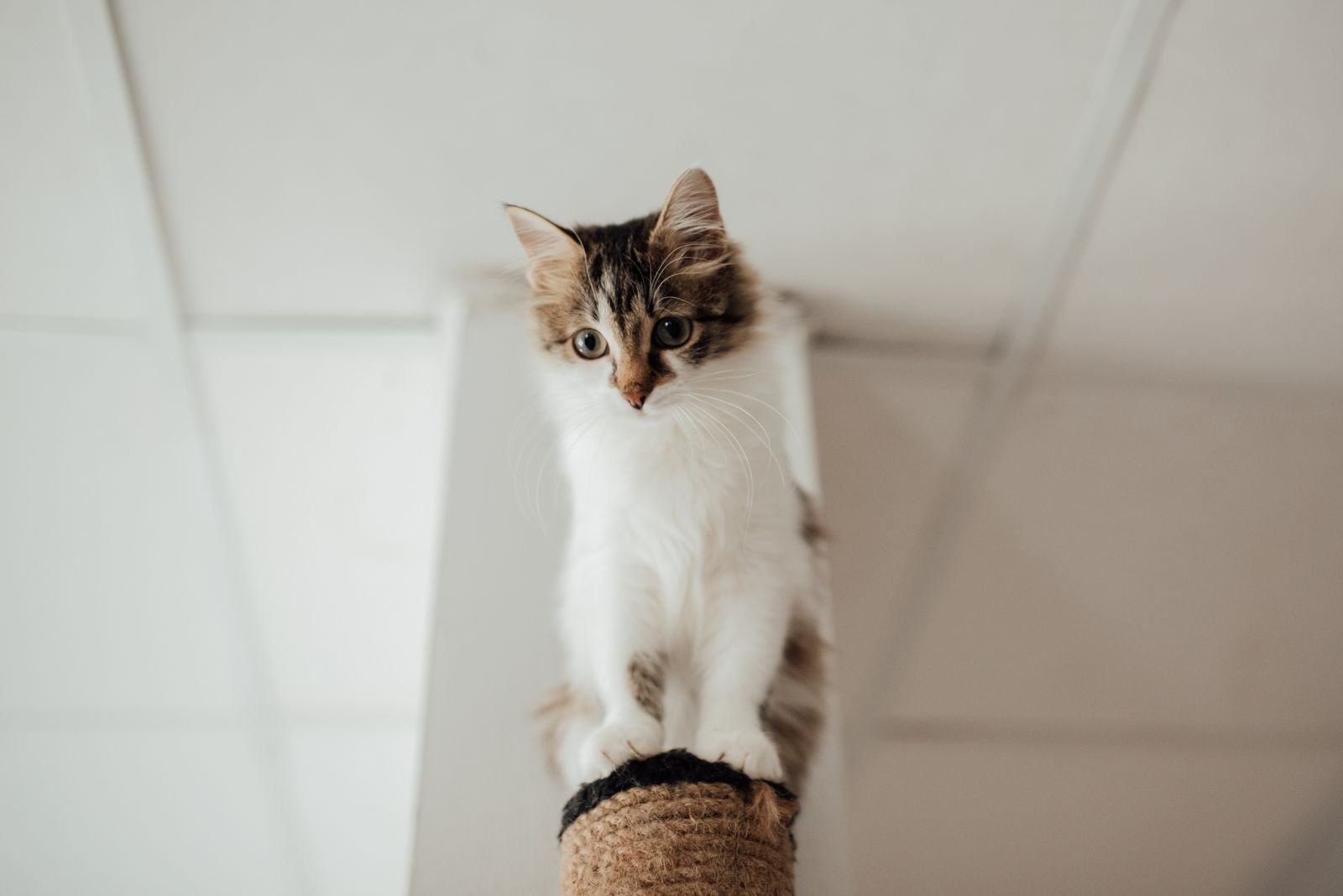
Surface comes third. Sisal rope has ridges that catch a claw and lets a cat pull down hard without the whole thing coming apart. Corrugated cardboard shreds satisfyingly, costs little to replace, and suits the horizontal scratchers. Carpet-covered posts are the ones I would leave on the shelf. Teaching a cat that carpet is the right thing to scratch undoes the lesson you are paying for.
A cat tree is those same three rules stacked, with places to sit added. It earns the floor space in a busy multi-cat household, or in an apartment where the floor is already crowded. Cats need somewhere high to sit and somewhere private to withdraw to as much as they need something to scratch. In a one-cat home with a spare corner, a single good post does the same work for far less money.
Compare These Cat Scratchers
These three cover the shapes most cats will accept. The SmartCat Pioneer Pet Ultimate is the plain upright, a tall sisal column on a wide base. Reach for it when the damage is on furniture arms. The PetFusion Jumbo Lounge is the horizontal answer, a curved cardboard slab that doubles as a bed and suits the carpet scratchers. The Feandrea tower is the full cat tree, five levels with scratching surfaces throughout. It is the sensible choice for a cat with nowhere high to go.


Buy for the shape your cat already chose rather than the one that suits your living room. I would rather see a cheap cardboard lounge sitting in the middle of the floor where the cat wants it than a handsome tower in a corner nobody visits.
Placement Does More Than the Product
This is where most people lose, and it costs nothing to get right. Across more than twelve hundred cats, posts put in the areas a cat already used were better at redirecting scratching than posts tucked out of the way. The spare bedroom is not a location. It is a storage decision.
Put the post beside the thing being scratched, not across the room from it. Cats tend to scratch on waking and on greeting, so the end of the sofa and the patch by the front door are both sensible spots. Once it is being used reliably you can shift it a few inches a day toward somewhere you would rather have it.
Resist carrying your cat over and pressing their paws against it. In the owner survey, cats whose owners placed them next to the new item used it less rather than more. Rub a little catnip into it, play around the base of it, and let your cat find it in their own time.
Two decent posts in different rooms beat one perfect post in the wrong one. The same thinking applies to everything else a cat needs. A second litter box somewhere separate and water kept away from the food bowl both help more than owners expect.
When Scratching Means Something Is Wrong
Two changes are worth a second look rather than another purchase.
The first is a cat who used the tall post happily and has quietly stopped. Cats hide joint pain well, and when one hundred cats older than six were X-rayed, 61 percent had signs of osteoarthritis in at least one joint. A cat who has stopped jumping up to the high perches, or who now only scratches at floor level, may well be sore rather than bored. A low horizontal scratcher is a kindness while you book the examination.
The second is a sudden increase. Unwanted scratching rises and falls with how busy and how settled a cat is. The same large study tied it to play, nighttime activity and disruptive behavior at home. A new baby, a new cat, or a house full of visitors often shows up in the furniture before it shows up anywhere else. When the scratching arrives alongside urinating outside the litter box, treat that as a sign worth investigating properly rather than a discipline problem.
It is also worth checking what is actually being scratched. A cat scratching at their own skin rather than the furniture has a different problem entirely. Fleas are one of the first things to rule out, even in a cat that never goes outside, and a flea treatment that is safe for cats is where that starts.
Go to an emergency vet now if your cat is straining in the litter box and passing little or no urine, and treat it as an emergency in a male cat in particular. A blocked urethra stops potassium leaving the body, rising potassium slows and disturbs the heartbeat, and a fully blocked cat can die in less than a day or two. This one does not wait until morning.
For everything else, this is one of the cheaper problems in cat ownership to solve. Match the shape to whatever your cat is already ruining, buy something tall enough and solid enough to lean on, stand it where your cat actually spends the day, and let them discover it themselves. The sofa recovers faster than you would think.
This article is for educational purposes only and is not a substitute for professional veterinary care. Always consult a licensed veterinarian regarding your pet’s health and nutritional needs. As an Amazon Associate, Vet Explains earns from qualifying purchases.
Was the article helpful?
My Norwegian is too tall for almost all scratching posts. I’ve got an old one that’s both tall enough and stable (many don’t have a large enough base), but the carpet is worn out.
they sell floor to ceiling cat posts that are just one long post covered in sisal. I’m pretty sure that will be big enough for your cat. Or you could go to a carpet store and ask for scraps or to a store like the Habitat for Humanity Store and buy some leftovers and replace the carpet on the one you already have.