

Your dog has started coughing. Maybe it is a dry honk that began after a weekend at the kennel, or a soft cough you only notice when the house is quiet. A cough is a sign, not a diagnosis, and the list behind it runs from a throat infection that clears on its own to heart or lung disease. The sound, how long it has lasted, and how your dog breathes between coughs will sort most of that list before any test is run.
One thing overrides everything below. A dog that is working hard to breathe, breathing fast with an open mouth while resting, or showing blue or gray gums is in respiratory distress. Not enough oxygen is getting in, so go to the nearest emergency vet immediately instead of reading on.
What the Sound of the Cough Tells You
Start by listening. A high-pitched, dry cough that sounds like a goose honking usually comes from the upper airway, where something is irritating or narrowing the windpipe. Kennel cough and a collapsing trachea are the two usual suspects. A wet cough that sounds as if it is bringing something up is a different conversation, because in a dog that is already sick it can mean an infection has reached the lungs.
Two things are easy to misread. Many dogs retch or gag at the end of a coughing fit, which looks like vomiting. Spasms of harsh, dry coughing followed by retching and gagging are typical of an inflamed windpipe, not a stomach problem. And a loud honking noise pulled in through the nose in rapid snorts is more likely reverse sneezing than a cough.
Kennel Cough: The Sudden Honk After Time With Other Dogs
Infectious tracheobronchitis, better known as kennel cough, is the classic cause of a frequent, honking cough that comes on suddenly. (The name is built from the Greek “trakheia,” windpipe, and “bronchos,” airway, plus “-itis,” inflammation.) Dogs pick it up where dogs gather, such as kennels, shelters, and daycare. Vets now tend to call it canine infectious respiratory disease complex, because several different viruses and bacteria can produce the same cough.
In most cases the illness is mild, and dogs fully recover within 7 to 10 days. There is no special drug for it. Care is mostly rest and avoiding whatever sets off the coughing, and antibiotics are not usually needed unless there are signs of pneumonia.
What changes the picture is a dog that gets sicker instead of better. Lethargy, a poor appetite, fever, a wet cough, or rapid or labored breathing can mean bacteria have infected the lungs. That is bacterial pneumonia, and it needs a vet immediately, not at the next free appointment. Call too if the cough has not started to improve within a week.

Collapsing Trachea in Small Dogs
In toy and small breeds such as Yorkshire Terriers, Pomeranians, and Toy Poodles, a honking cough in a middle-aged or older dog raises a different suspicion. The windpipe is held open by rings of cartilage. In a collapsing trachea those rings weaken and flatten, the airway narrows, and the result is a persistent, harsh, dry cough. Stress, excitement, exercise, heat and humidity, smoke, and pressure on the neck can all make it worse.
This is a progressive disease, so the aim is to manage it, not to wait for it to pass. The simplest thing you can change at home is the collar. A leash clipped to a neck collar presses on the part of the airway that is already too narrow, which is why switching to a harness instead of a collar is standard advice for these dogs. Extra weight is worth raising with your vet too, because obesity is one of the conditions that needs attention alongside the trachea itself.

Could the Cough Be a Heart Problem?
Heart disease belongs on the list too. When the left side of the heart fails, pressure backs up and fluid accumulates within the lungs, which is called pulmonary edema. (From the Latin “pulmo,” lung, and the Greek “oidema,” swelling.) Coughing, difficulty breathing, and tiring quickly with exercise are the most common signs, and many of these dogs faint.
Who gets which disease depends largely on size. Mitral valve disease, a leaky valve on the left side of the heart, is mostly diagnosed in small-breed dogs of middle to older age, and Cavalier King Charles Spaniels, Dachshunds, and miniature and toy Poodles are all on the list. Dilated cardiomyopathy, a weak and enlarged heart muscle, is a disease of large and giant breeds, with a very high incidence in Doberman Pinschers and Boxers.
Here is where it gets more complicated. A cough in a dog with a heart murmur does not necessarily mean heart failure. An enlarged heart can press on the nearby airways and cause a cough with no fluid in the lungs at all. The more useful thing to watch is breathing at rest, because a resting breathing rate that climbs above your dog’s normal baseline is the best early warning that the heart is losing ground. If your dog has a murmur, ask your vet to show you how to count it.

Smoke, Fumes, and the Cough That Never Leaves
Not every long-running cough is an infection or the heart. Smoke and chemical fumes can inflame the airways on their own, and smoke is also one of the things that aggravates a collapsing trachea. When a cough persists for at least two months and no other respiratory disease explains it, vets call it chronic bronchitis. That cough tends to be worst after rest, after a change of environment, or at the start of exercise.
An allergic reaction in the lungs can do the same thing, and a chronic cough is its most common sign. Tell your vet what your dog breathes in at home and when the cough is worst, because those two details narrow the list quickly.

When Is a Cough an Emergency?
Most coughing dogs are not emergencies. A cough becomes one when it comes with trouble breathing, because at that point the problem is oxygen, not noise. If you see any of the signs of a dog struggling to breathe listed below, go to the nearest emergency vet immediately, and do not wait to see whether it settles. The same applies to a dog that faints or whose tongue turns blue during a coughing fit.
- 01
Open-mouth breathing at rest
Fast breathing with the mouth open while your dog is resting.
- 02
Blue or gray gums
A bluish or gray tinge to the gums, tongue, or muzzle.
- 03
Belly working to breathe
The abdomen tightening with every breath, or the head and neck stretched forward.
- 04
Weakness, collapse, or fainting
A dog that goes down, cannot stand, or passes out during a coughing fit.
What the Vet Will Do to Find the Cause
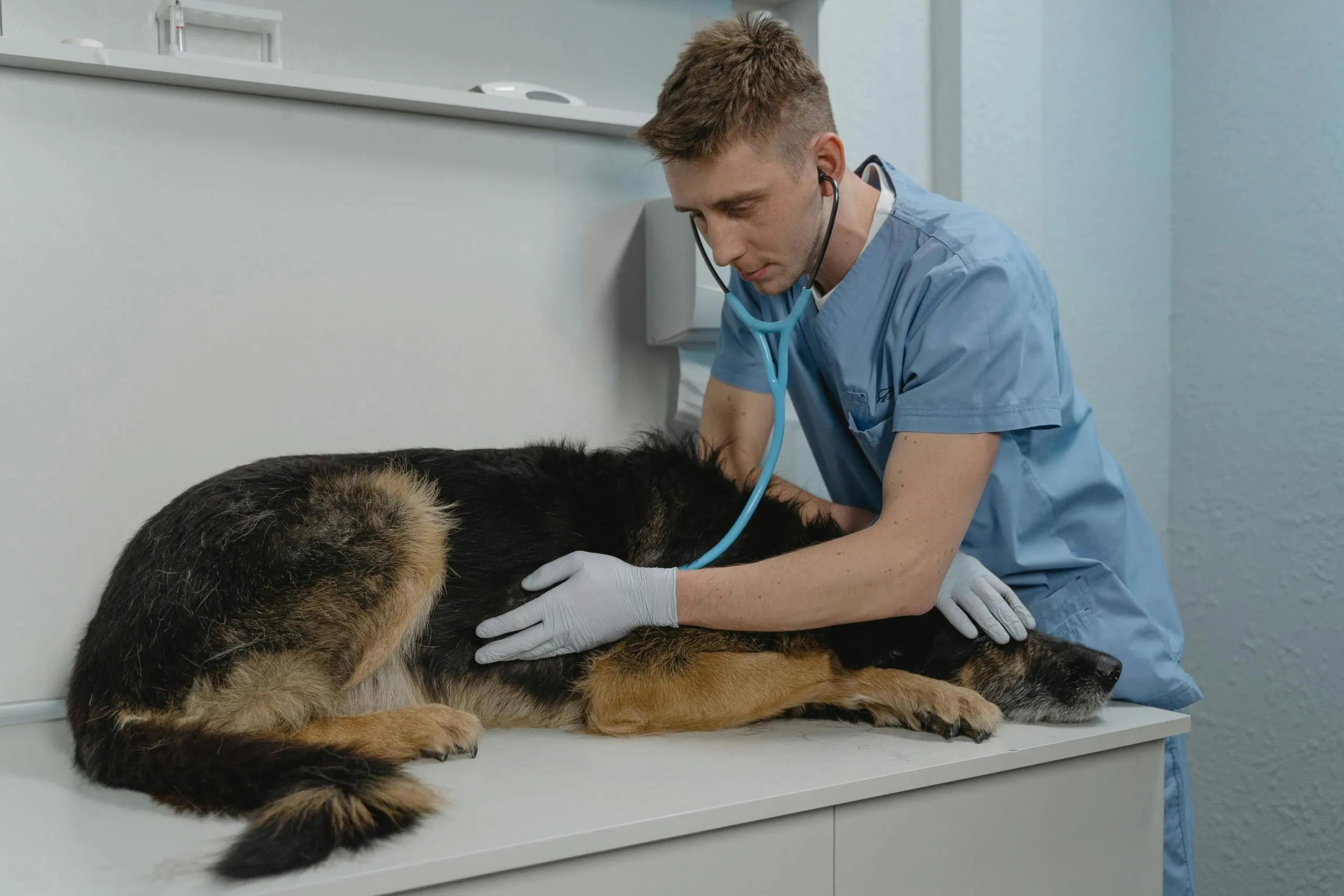
Expect questions first: when the cough started, what it sounds like, and whether your dog has been around other dogs. Then comes the physical exam, including auscultation, which is listening to the heart and lungs with a stethoscope. (From the Latin “auscultare,” to listen.)
If the cough has lasted or the exam raises a concern, chest X-rays are often the next step. A few dogs need a camera passed down the airway, called bronchoscopy, with samples taken for the lab. Because heartworm disease can cause a mild, persistent cough, your vet may add a heartworm test, especially if doses of prevention have been missed. Bring a short phone video of the cough, because your dog may not cough in the exam room.
Was the article helpful?